
Dalahästen: Sweden's Iconic Folk Art Horse
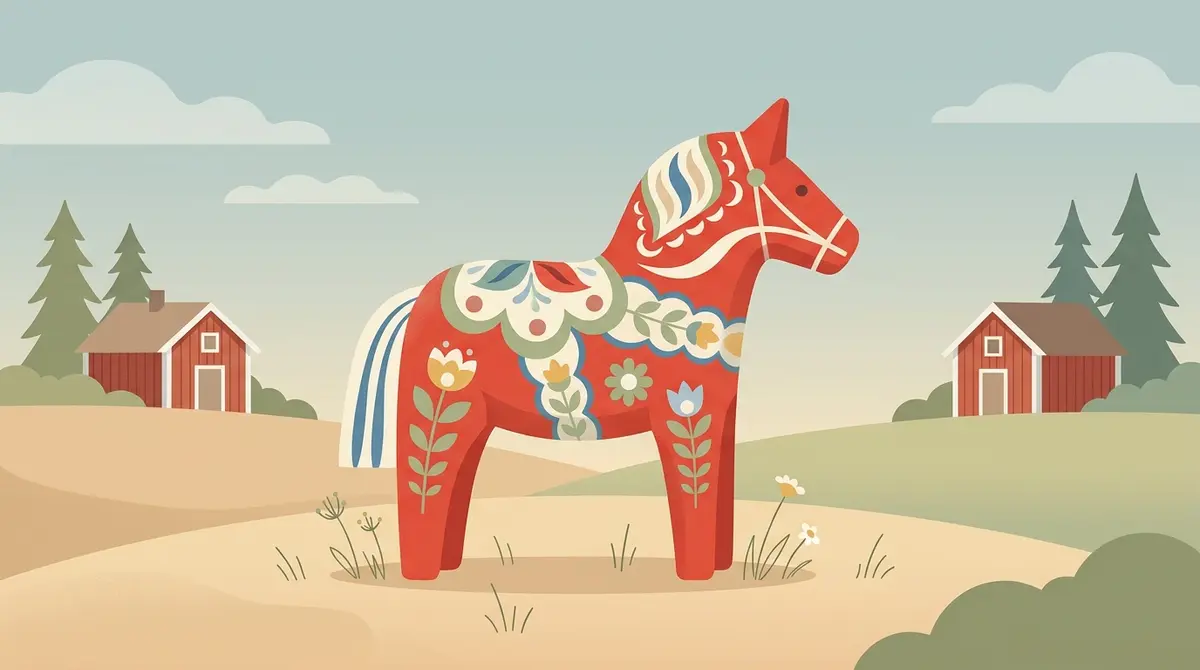
If you visit a Swedish souvenir shop, an airport, or even a typical Swedish home, you will almost certainly spot a brightly painted wooden horse. This little figure is en dalahäst (a Dala horse), and it is perhaps Sweden’s most famous folk art symbol. But behind the vibrant orange-red coat and curling floral patterns lies a history of humble craftsmanship, winter evenings by the hearth, and an accidental rise to global design fame.
Born in the Deep Forests of Dalarna
The story of dalahästen begins in the province of Dalarna in central Sweden. During the seventeenth and eighteenth centuries, men spent long winter months working deep in the pine forests as timber fellers. In the evenings, gathered around the fire in their simple log cabins, they used small knives to carve scraps of wood into toys for their children back home.
The horse was a natural choice of subject. In rural Sweden, a strong working horse was a family's most valuable companion. It pulled heavy timber through snowdrifts, ploughed stony fields, and transported goods across frozen lakes. Carving a horse was an act of respect and affection.
By the early 1800s, travelling pedlars from the villages around Lake Siljan began selling these little carved horses at country markets. Women and local painters added bright floral decorations known as kurbits, a traditional style of decorative painting with swirling leaves and oversized fantasy flowers. Soon, whole farming families spent dark winter nights carving and painting horses to earn a little extra income.
From Forest Toy to World Design Icon
For a long time, the Dala horse was simply a beloved local toy. Everything changed in 1939 at the World's Fair in New York.
Architects designing the Swedish pavilion wanted a bold, cheerful symbol to welcome visitors. They commissioned a giant three-metre-tall red Dala horse to stand outside the exhibition hall. American newspapers fell in love with it, photographs spread around the world, and sudden international demand turned this simple wooden carving into a national symbol of Sweden.
Today, genuine Dala horses are still made by hand in the village of Nusnäs, near the town of Mora. Skilled craftsmen rough-carve blocks of local pine using band saws, shape each horse with a sharp knife, dip it in paint, and then paint the kurbits patterns freehand with a double-tipped brush. Because each piece is painted by hand, no two horses look completely identical. Today, you can spot these colourful figures decorating shelves in many a Swedish home, as people love to display classic design pieces hemma.
The name itself is also a great example of how Swedish puts words together—a topic you can explore further in our guide to Swedish compound words. Here, Dalarna (the province) combines with en häst (a horse) to form en dalahäst.
Language Corner: Talk About Art and Crafts
When you visit Sweden or chat with Swedish friends, you will often talk about design, souvenirs, and handmade items. Here are five natural phrases you can use right away:
- Den är gjord av trä. (It is made of wood.)
- Hästen är målad för hand. (The horse is painted by hand.)
- Vilken fin färg! (What a lovely colour!)
- Det är en gammal tradition. (It is an old tradition.)
- Jag vill köpa en souvenir. (I want to buy a souvenir.)
Here is a list of essential Swedish words related to folk art and design:
| Swedish | English | Example |
|---|---|---|
| ett trä | wood | Bordet är gjort av trä. (The table is made of wood.) |
| en häst | a horse | Han har en röd häst. (He has a red horse.) |
| att tälja | to whittle, to carve wood | Morfar tycker om att tälja. (Grandpa likes to whittle.) |
| att måla | to paint | Hon målar en vacker blomma. (She paints a beautiful flower.) |
| en färg | a colour, a paint | Röd är en klassisk färg. (Red is a classic colour.) |
| slöjd | crafts, woodwork | Vi har slöjd i skolan. (We have crafts class at school.) |
| ett mönster | a pattern | Jag gillar hästens mönster. (I like the horse's pattern.) |
Did You Know?
While red is the classic colour for a Dala horse, you can also find traditional horses in blue, black, white, and even untreated natural wood. In recent years, artisans have introduced modern pastels and even rainbow patterns, but the bright red version—originally coloured with pigments from the copper mine in Falun—remains the undisputed favourite.
Practise This with Kielo
Try using these design words next time you speak Swedish. You can practise describing colours and objects in a Kielo conversation, and add these useful nouns to your daily review plan. Hästen är målad för hand.
- Learn Swedish
- Dalahäst
- Swedish Culture
- Design and Arts
- Swedish Folk Art
- Dalarna
Practise this Swedish with Kielo
AI conversations, short articles at your level and exercises built around your mistakes.
Download Kielo