
Vad är det för väder: Talk About Swedish Weather
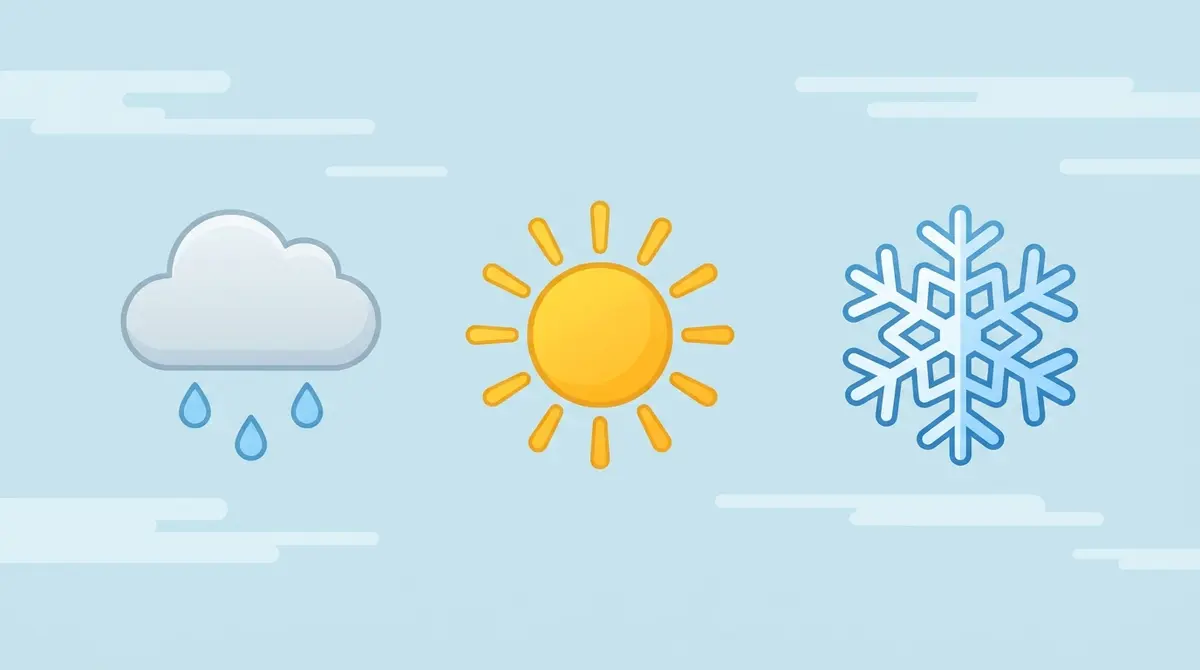
If you want to start a conversation in Sweden, there is one topic that never fails: vädret (the weather). Because Swedish seasons swing dramatically from crisp, bright summer days to dark, icy November mornings, people check forecasts constantly and discuss the forecast with colleagues, neighbours, and cashiers. Learning how to talk about the weather gives you an effortless bridge into daily Swedish small talk.
Asking About the Weather
To kick off a conversation, you need to know how to ask what is happening outside. Swedish has two very common ways to ask this:
- Vad är det för väder idag? (What is the weather like today?)
- Hur är vädret? (How is the weather?)
The first phrase, Vad är det för väder?, literally translates to "What is it for weather?", but it simply means "What is the weather like?". It is the most natural, idiomatic way to ask the question.
If you are checking the forecast for later or tomorrow, swap out idag (today):
- Vad blir det för väder imorgon? (What will the weather be like tomorrow?)
- Ska det regna ikväll? (Is it going to rain this evening?)
The Magic Word: "Det"
Just like in English, Swedish uses an impersonal pronoun to describe weather conditions. In Swedish, that word is det (it).
Notice how verbs and adjectives pair with det:
- Det regnar. (It is raining.)
- Det snöar. (It is snowing.)
- Det blåser. (It is windy. / literally: It blows.)
- Det är soligt. (It is sunny.)
- Det är mulet. (It is overcast.)
- Det är kallt. (It is cold.)
- Det är varmt. (It is warm / hot.)
You can also talk about the sun directly: Solen skiner (The sun is shining).
Watch out for this common mistake!
In English, you might say "I am cold." If you translate that directly as "Jag är kall", Swedes will understand what you mean, but it sounds like your body is literally cold to the touch (like an ice cube!).
To say that you feel cold, use the verb frysa (to freeze / to feel cold):
- Jag fryser! (I am cold! / I am freezing!)
Talking About Temperatures: Plus and Minus
Sweden uses the Celsius scale, and degrees are called grader. When discussing temperatures, Swedes often specify whether it is above or below zero:
- plusgrader (degrees above freezing)
- minusgrader (degrees below freezing)
Here is how you describe the thermometer in everyday speech:
- Det är tio grader idag. (It is ten degrees today.)
- Det är tre plusgrader. (It is three degrees above zero.)
- Det är fem minusgrader. (It is minus five degrees.)
In casual speech, people often shorten minus temperatures: Det är fem minus (It is minus five).
When you wake up and start your morning, glancing at the temperature helps you pick the right jacket before stepping outside.
Useful Swedish Weather Vocabulary
Here are the most essential weather terms you will hear and read in Sweden:
| Swedish | English | Example |
|---|---|---|
| ett väder | weather | Vädret är fint idag. (The weather is nice today.) |
| en sol | a sun | Solen skiner hela dagen. (The sun is shining all day.) |
| ett regn | a rain | Jag gillar inte regn. (I do not like rain.) |
| snö (en) | snow | Kommer det snö imorgon? (Is snow coming tomorrow?) |
| ett moln | a cloud | Det finns inga moln på himlen. (There are no clouds in the sky.) |
| en vind | a wind | Det är en kall vind idag. (There is a cold wind today.) |
| dimma | fog / mist | Det är mycket dimma vid kusten. (There is a lot of fog by the coast.) |
| en prognos | a forecast | Har du sett väderprognosen? (Have you seen the weather forecast?) |
| en paraply / ett paraply | an umbrella | Glöm inte ditt paraply! (Don't forget your umbrella!) |
Weather in Real Swedish Life
Swedes take weather seriously, but they never let bad weather stop them from going outside. You will often hear a popular Scandinavian saying:
Det finns inget dåligt väder, bara dåliga kläder.
(There is no bad weather, only bad clothes.)
Children in Swedish preschools play outdoors in all conditions, wearing waterproof overalls called galonbyxor (rain trousers). Adults invest in functional, insulated coats and sturdy boots.
Weather is also the number one topic for small talk during an afternoon fika break with colleagues. You will often hear people commiserate over a sudden downpour with a gentle sigh and a smile: Vilket väder! (What weather!). If a warm sunny spell arrives in spring, you will hear a joyful Vilket härligt väder! (What lovely weather!).
Quick Practice
Translate these sentences or fill in the blank. Check your answers below!
- Fill in the blank: "It is snowing today." -> Det _____ idag.
- Translate to Swedish: "The sun is shining."
- Translate to Swedish: "I am cold!" (Hint: do not use the adjective kall!)
Answers
- Det snöar idag.
- Solen skiner.
- Jag fryser!
Practise this with Kielo
You can practise asking about the forecast and describing your local climate in a conversation on Kielo. Add these weather phrases to your daily review deck to make sure they stick before your next chat in Swedish.
Vad är det för väder idag?
- Learn Swedish
- Swedish Vocabulary
- Swedish Weather
- Swedish Small Talk
- Beginner Swedish
Practise this Swedish with Kielo
AI conversations, short articles at your level and exercises built around your mistakes.
Download Kielo