
Vad gör du på fritiden? Talk About Hobbies in Swedish
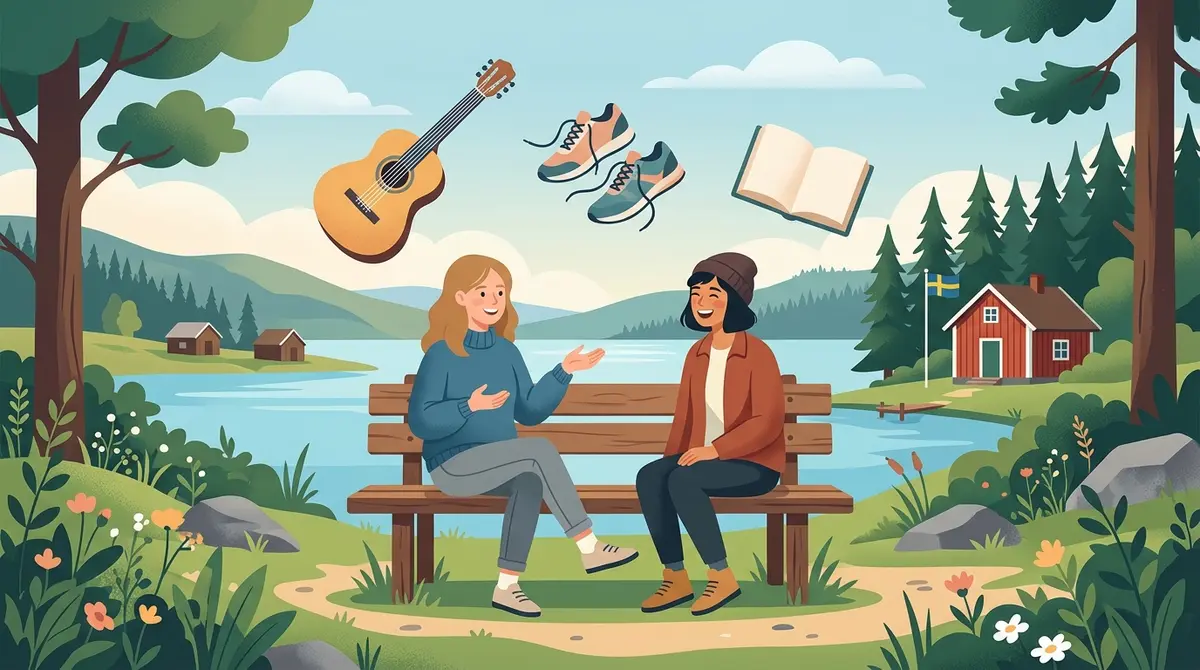
Making new friends in Sweden often starts with casual small talk. While asking Vad jobbar du med? (what do you do for work?) is common, asking people what they do when they are not working is the best way to get to know someone. Hobbies are a huge part of everyday life in Sweden. Learning how to talk about your interests will help you connect with colleagues, join local groups, and feel right at home.
How to ask about hobbies
To start the conversation, you only need one or two go-to questions. The most common phrase is:
- Vad gör du på fritiden? (What do you do in your free time?)
The word fritid (free time) is a compound made of fri (free) and tid (time). Notice the preposition: in Swedish, you do things på fritiden (in your free time), not "i".
You can also ask:
- Vad har du för intressen? (What interests do you have?)
- Vad gillar du att göra? (What do you like to do?)
When someone asks you this, you can answer with Jag tycker om att... (I like to...) or Jag gillar att... (I like to...). Both mean the same thing. Just remember to add att (to) before the verb:
- Jag gillar att läsa böcker. (I like to read books.)
- Jag tycker om att laga mat. (I like to cook food.)
Another handy verb for A1 and A2 learners is brukar (usually / to have the habit of). You follow it directly with an infinitive verb, without att:
- På helgen brukar jag vandra. (On the weekend I usually hike.)
Spela or leka: how to say "play"
One of the most frequent mistakes English speakers make is mixing up spela and leka. Both translate to "play", but Swedish keeps them strictly separate.
Use spela when an activity has rules, points, a board, or an instrument:
- Jag spelar fotboll. (I play football.)
- Hon spelar gitarr. (She plays guitar.)
- Vi spelar datorspel. (We play computer games.)
- De spelar schack. (They play chess.)
Use leka when children play together, invent pretend games, or run around for fun without strict rules:
- Barnen leker i trädgården. (The children are playing in the garden.)
- Hunden vill leka. (The dog wants to play.)
If you say jag leker gitarr, native speakers will smile because it sounds like you are pretending a broomstick is a guitar! If you play an actual instrument or a sport, always choose spela.
Useful Swedish phrases for hobbies
Here are everyday words and verbs you can use to talk about your free time:
| Swedish | English | Example |
|---|---|---|
| en hobby | a hobby | Har du någon hobby? (Do you have any hobby?) |
| att träna | to work out / exercise | Jag tränar tre gånger i veckan. (I work out three times a week.) |
| att springa | to run / jog | Han gillar att springa på kvällen. (He likes to run in the evening.) |
| att sticka | to knit | Min syster tycker om att sticka. (My sister likes to knit.) |
| att resa | to travel | Vi älskar att resa till nya platser. (We love to travel to new places.) |
| att lyssna på musik | to listen to music | Jag brukar lyssna på musik när jag städar. (I usually listen to music when I clean.) |
| att vara ute i naturen | to spend time in nature | Många svenskar gillar att vara ute i naturen. (Many Swedes like being out in nature.) |
| att umgås med vänner | to spend time with friends | På lördagar brukar jag umgås med vänner. (On Saturdays I usually hang out with friends.) |
Club culture and "föreningsliv" in Sweden
To understand hobbies in Sweden, you have to understand föreningsliv (association life or club culture). A förening is a non-profit association or club run by its members. Sweden has roughly 160,000 non-profit associations (SCB), covering everything from running (löpning) and choir singing (korsång) to gardening and board games.
Joining an idrottsförening (sports club) or another local association is one of the easiest ways for newcomers to integrate. Members often train together and then stay for a warm fika (coffee and pastry break). Because so many activities are communal, sharing your hobbies is not just idle chat—it is an invitation to share an experience.
Quick practice
Test what you have learned by choosing the right word or phrase for each sentence.
-
"I like to play piano."
- A) Jag tycker om att leka piano.
- B) Jag tycker om att spela piano.
-
Fill in the missing preposition: "What do you do in your free time?"
- Vad gör du ___ fritiden?
-
"On Sundays I usually exercise."
- A) På söndagar brukar jag träna.
- B) På söndagar brukar jag att träna.
Answers:
- B (spela, because an instrument requires musical play, not imaginative child play).
- på (på fritiden is the correct preposition in Swedish).
- A (the verb brukar takes an infinitive without att).
Practise this with Kielo
Try sharing your favorite pastimes during your next interactive chat in Kielo. You can test different hobby verbs, learn vocabulary tailored to your real-life interests, and review these phrases in your daily study plan. Start by answering this simple question: Vad gör du på fritiden?
- Learn Swedish
- Swedish vocabulary
- Hobbies and Free Time
- Swedish verbs
- Swedish speaking
- A1 Swedish
Practise this Swedish with Kielo
AI conversations, short articles at your level and exercises built around your mistakes.
Download Kielo