
Lördagsgodis: Sweden’s Sweet Saturday Tradition
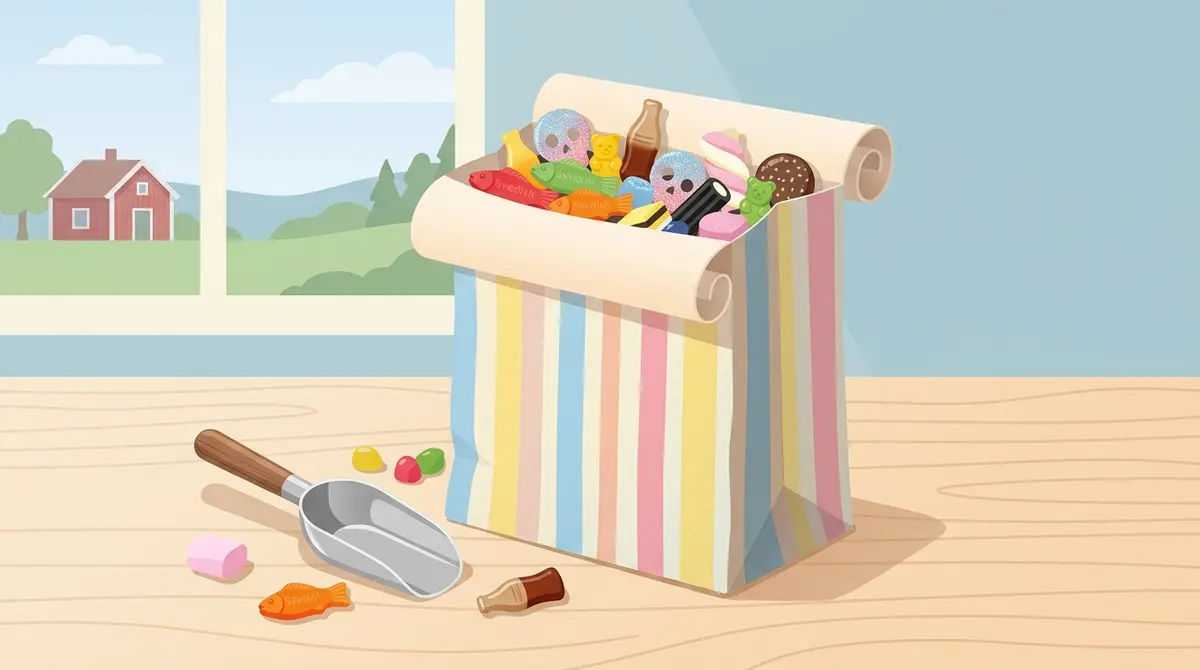
If you walk into a Swedish supermarket on a Saturday afternoon, you will notice a huge crowd gathered in front of an entire wall of colourful sweets. Children holding paper bags stand next to adults with plastic scoops, carefully inspecting rows of plastic bins. This is lördagsgodis (Saturday sweets), one of Sweden’s most beloved weekly traditions.
The concept is simple: children and adults save their sweet treats for one designated day of the week—Saturday. For foreigners living in Sweden, experiencing the ritual of picking lösgodis (pick-and-mix candy) is an essential cultural milestone.
The wall of pick-and-mix
In Swedish shops, sweets are not usually sold only in small pre-packaged bars. Instead, supermarkets dedicate entire aisles to lösgodis (pick-and-mix sweets), also known as smågodis (little candy). You grab a paper bag, called en godispåse (a candy bag), take a plastic or metal scoop (en godisskopa), and walk down rows containing dozens of different varieties.
You will find soft foam sweets, chocolate bites, gummies shaped like cars or bananas, and Sweden’s legendary obsession: saltlakrits (salty liquorice, often flavoured with salmiak). Swedes love mixing intense flavours in the same bag. Sweet strawberry gelée often sits right next to pitch-black ammonium chloride diamonds.
When your bag is full, you place it on a scale at the checkout. Candy in Sweden is usually priced by weight, measured in ett hekto (one hectogram, or 100 grams).
Where did the tradition come from?
While lördagsgodis sounds like pure indulgence, it is usually traced back to dental-health advice from the 1950s, when tooth decay was a major public-health concern in Sweden. The Vipeholm experiments, run at a hospital near Lund from 1945 and published in 1953, tied sweets eaten between meals to much more tooth decay. One practical result was the advice that it is better for children’s teeth to eat sweets once a week than small amounts spread across the week. The study is now widely criticised on ethical grounds, because its subjects were residents of an institution.
Swedish health authorities then recommended that families keep sweets to one day a week, and the habit spread widely.
What started as strict dental advice gradually turned into a festive, cosy ritual. Today, it signals the start of the weekend. For many kids, a little pocket money to choose their own treats is a lesson in both budgeting and moderation. And plenty of adults enjoy it just as much and keep the habit of filling a bag on Saturday evening.
Language corner
When you want to talk about sweets, flavours, and weekend shopping in Swedish, these everyday phrases will help you get started:
- Ska vi köpa lördagsgodis? (Shall we buy Saturday sweets?)
- Hur mycket kostar det per hekto? (How much does it cost per 100 grams?)
- Jag tycker mest om choklad. (I like chocolate the most.)
- Tycker du om saltlakrits? (Do you like salty liquorice?)
- Vi delar på en påse. (We will share a bag.)
Here are the key words to know before your next trip to the sweet shop:
| Swedish | English | Example |
|---|---|---|
| godis | sweets, candy (a mass noun; one piece is en godisbit) | Barnen äter godis idag. (The children are eating sweets today.) |
| lösgodis | pick-and-mix candy | Affären har mycket lösgodis. (The shop has a lot of pick-and-mix candy.) |
| en påse | a bag | Jag fyller en påse. (I am filling a bag.) |
| choklad | chocolate | Mörk choklad är god. (Dark chocolate is tasty.) |
| söt | sweet | Den här karamellen är söt. (This hard candy is sweet.) |
| sur | sour | Jag köper ofta surt godis. (I often buy sour candy.) |
| salt | salty | Lakritsen smakar salt. (The liquorice tastes salty.) |
| ett hekto | a hectogram (100g) | Godiset kostar nio kronor per hekto. (The candy costs nine kronor per 100 grams.) |
Did you know?
Sweden is often ranked among the world’s biggest candy-eating countries. Self-service pick-and-mix, approved by the health authorities in the 1980s, helped make lösgodis a habit.
Practise this with Kielo
You can practise asking for flavours and talking about your weekend habits in a Kielo conversation right away. Review these food and shopping words in your daily plan so you remember them next time you visit a shop. Ska vi köpa lördagsgodis?
- Learn Swedish
- Culture and Traditions
- Swedish Food
- Swedish Lifestyle
- Vocabulary
Practise this Swedish with Kielo
AI conversations, short articles at your level and exercises built around your mistakes.
Download Kielo