
Osata vs. Voida: How to Say "Can" in Finnish
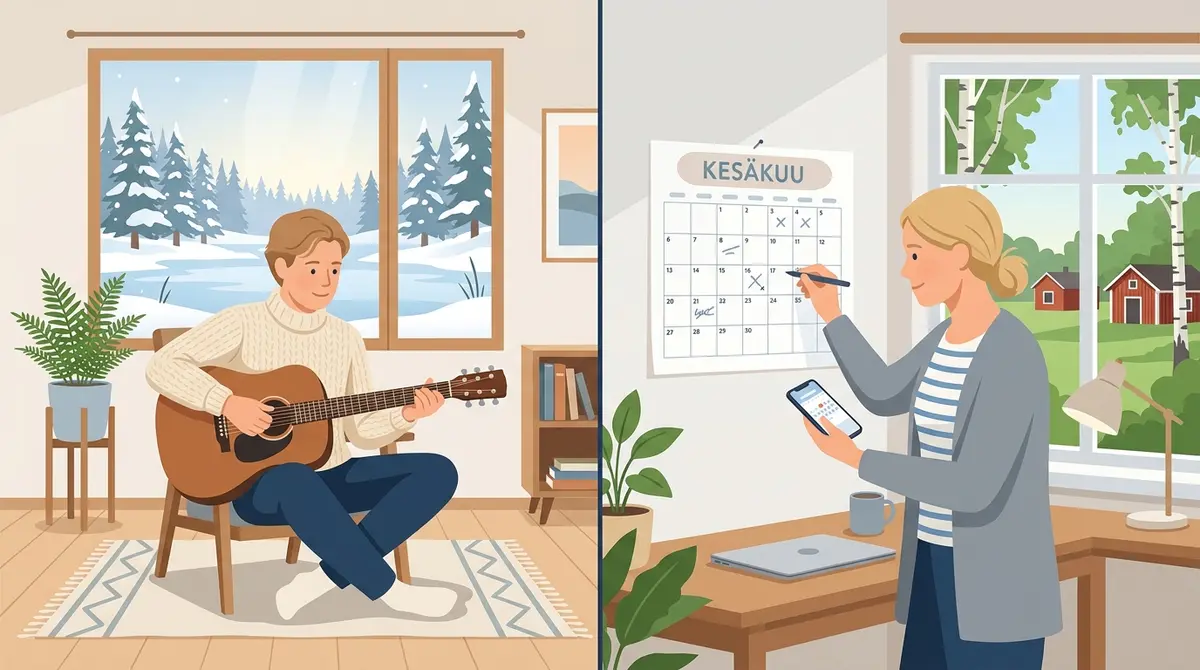
In English, the tiny word "can" does an enormous amount of heavy lifting. You use it to say that you know how to play the piano, that you are free to grab lunch on Friday, or that you have permission to open a window. In Finnish, however, using the wrong verb for "can" can lead to comical misunderstandings.
Finnish splits "can" into two primary verbs: osata (to know how / to have the skill) and voida (to be able to / to have the opportunity). Once you see the split, choosing the verb is easy.
Osata: The Power of Learned Skills
Think of osata as your "skill verb." Whenever you are talking about something you learned through practice, education, or experience, osata is the verb you need. It corresponds closely to the English phrase "to know how to."
Just like most Finnish verbs, osata drops its ending to form the stem (osa-) and adds standard personal endings in the present tense:
- minä osaan (I can / I know how to)
- sinä osaat (you can)
- hän osaa (he/she can)
- me osaamme (we can)
- te osaatte (you all can)
- he osaavat (they can)
When you combine osata with another action, the second verb stays in its basic dictionary form (the first infinitive):
- Osaan uida. (I can swim. / I know how to swim.)
- Osaatko puhua suomea? (Can you speak Finnish?)
- En osaa ajaa autoa. (I cannot drive a car. / I don't know how to drive.)
If an activity requires learning rules, training muscle memory, or acquiring knowledge, reach for osata.
Voida: Possibility, Time, and Circumstance
While osata lives in your brain and muscles, voida depends on the world around you. You use voida when circumstances, schedule, health, or permission allow you to do something. It translates best to "to be able to" or "it is possible for me."
Here is how voida conjugates in the present tense:
- minä voin (I can / I am able to)
- sinä voit (you can)
- hän voi (he/she can)
- me voimme (we can)
- te voitte (you all can)
- he voivat (they can)
Just like osata, voida connects directly to a second verb in its basic form:
- Voin auttaa sinua huomenna. (I can help you tomorrow.)
- Voitko avata oven? (Can you open the door?)
- En voi syödä pähkinöitä. (I cannot eat nuts. — Due to an allergy, not a lack of skill!)
If you are looking to make your sentences sound smoother, pairing these verbs with basic adverbs is a great next step. Take a look at our guide on crafting clearer sentences with Finnish adverbs to expand your phrasing.
The Classic Trap: "En osaa" vs. "En voi"
The easiest way to see the difference between these two verbs is in the negative.
Imagine a friend invites you to a dinner party on Saturday, but you are already busy working. If you reply:
- En osaa tulla. (I don't know how to come.)
Your friend might wonder if you forgot how to walk, drive, or find their street address! What you actually mean to say is:
- En voi tulla. (I cannot come. / I am not able to come.)
Here is a quick cheat sheet to keep them apart:
- Did you have to learn it? Use osata (Osaan laulaa — I can sing).
- Is it about your schedule, the weather, health, or permission? Use voida (Voin tulla kello viisi — I can come at five o'clock).
Essential "Can" Phrases in Finnish
| Finnish | English | Example |
|---|---|---|
| osata | to know how to (skill) | Osaan lukea karttaa. (I can read a map.) |
| voida | to be able to (possibility) | Voitko auttaa minua? (Can you help me?) |
| Osaatko suomea? | Do you speak/know Finnish? | Osaatko suomea hyvin? (Do you know Finnish well?) |
| En voi tulla. | I can't come (busy/sick). | En voi tulla tänään töihin. (I can't come to work today.) |
| En osaa sanoa. | I can't say / I don't know. | En osaa sanoa, missä bussi on. (I can't say where the bus is.) |
| Voimmeko maksaa? | Can we pay? | Voimmeko maksaa kortilla? (Can we pay by card?) |
| Voinko kysyä jotain? | Can I ask something? | Anteeksi, voinko kysyä jotain? (Excuse me, can I ask something?) |
| Osaan vähän. | I know a little bit. | Puhutko englantia? – Osaan vähän. (Do you speak English? – I know a little.) |
Notice the phrase En osaa sanoa (I can't say / I don't know). Finns use this idiomatic phrase all the time when asked a question they don't have the expertise to answer!
In Real Life: Finnish Modesty and Politeness
When asking for assistance in a shop or cafe, starting with Voitko auttaa? (Can you help?) or Voinko saada kahvin? (Can I have a coffee?) is considered polite, clear, and perfectly natural.
You will also hear osata used with classic Finnish modesty. If you ask a local, Osaatko englantia? (Do you know English?), they will frequently reply, Osaan vain vähän (I only know a little)—right before having a flawless, twenty-minute conversation with you in fluent English.
Don't be afraid to adopt the phrase yourself when practicing: Osaan vähän suomea (I know a little Finnish) is the friendliest icebreaker you can use in Finland.
Quick Practice
Choose between the correct forms of osata or voida for each situation.
- You want to tell someone you know how to bake traditional cinnamon rolls.
- You have a doctor's appointment, so you cannot attend class today.
- You are standing at a train platform and need to ask a traveler if they can help you with a heavy suitcase.
Answers:
- Osaan leipoa korvapuusteja. (Learned culinary skill → osata)
- En voi tulla kurssille tänään. (Circumstance / schedule conflict → voida)
- Voitko auttaa minua? (Asking for physical assistance / availability → voida)
Practise this with Kielo
Try out both osata and voida during your next interactive chat in Kielo to see how naturally they fit into everyday dialogues. You will also find these verb forms waiting for you in your daily review deck so you never mix up skills and schedules again.
Osaan puhua vähän suomea! (I can speak a little Finnish!)
- Learn Finnish
- Finnish Verbs
- Verb Basics
- Finnish Grammar
- Everyday Finnish
Practise this Finnish with Kielo
AI conversations, short articles at your level and exercises built around your mistakes.
Download Kielo