
Vakna and Gå upp: Talk About Your Morning in Swedish
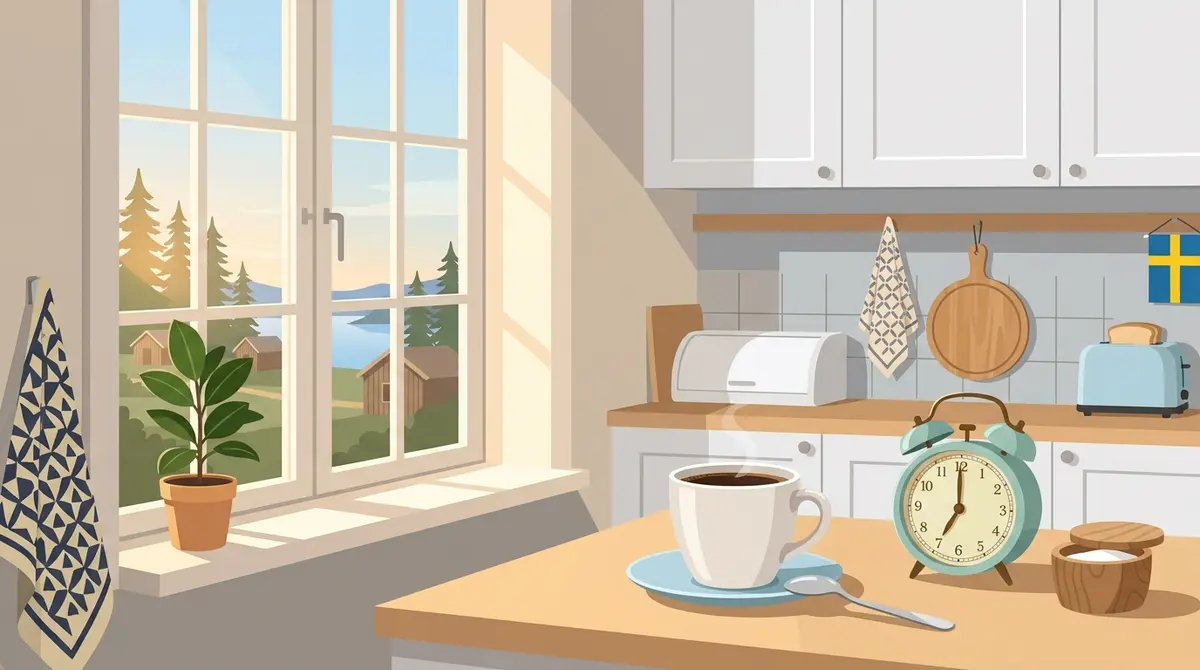
Daily routines are the backbone of everyday conversation. When a Swedish colleague asks Vad brukar du göra på morgonen? (What do you usually do in the morning?) or you simply want to describe your day in a language exchange, you need the right words for those first sleepy hours. Swedish has a few unique quirks when it comes to morning habits, from reflexive verbs to open sandwiches. Here is how to describe your morning step by step with natural, accurate Swedish.
Vakna or gå upp? The first moments of the day
Just like in English, Swedish makes a clear distinction between opening your eyes and actually leaving your warm mattress:
- att vakna (to wake up) describes the moment your sleep ends.
- att gå upp or att stiga upp (to get out of bed / to rise) describes putting your feet on the floor.
Listen to how you use them together:
- Väckarklockan ringer klockan sju. (The alarm clock rings at seven o'clock.)
- Jag vaknar direkt, men jag går inte upp förrän sju och tjugo. (I wake up right away, but I do not get up until seven twenty.)
A common mistake for English speakers is saying vakna upp when they mean getting out of bed. In Swedish, simply say jag går upp (I get up).
Getting ready: Reflexive verbs and the definite form
Once you are out of bed, your grooming routine begins. This is where Swedish shows off two important grammar patterns: reflexive verbs and body parts in the definite form.
First, Swedish uses reflexive pronouns when an action turns back on yourself:
- att klä på sig (to get dressed)
- att skynda sig (to hurry)
- att raka sig (to shave)
Remember to match the pronoun to the person:
- Jag klär på mig. (I get dressed.)
- Du klär på dig. (You get dressed.)
- Hon klär på sig. (She gets dressed.)
- Vi klär på oss. (We get dressed.)
Second, when Swedes talk about washing or brushing body parts, they rarely use possessive words like "my" or "your". Instead, they use the definite form of the noun:
- Jag borstar tänderna. (I brush my teeth; literally: "I brush the teeth.")
- Han tvättar ansiktet. (He washes his face; literally: "He washes the face.")
- Jag kammar håret. (I comb my hair; literally: "I comb the hair.")
Saying jag borstar mina tänder sounds unnatural in Swedish, because who else's teeth would you be brushing? Stick to tänderna (the teeth) and ansiktet (the face).
Fuel, time words, and leaving the house
Now comes the best part of the morning: breakfast.
- att äta frukost (to eat breakfast)
- att brygga kaffe (to brew coffee)
- att dricka te (to drink tea)
To tell a smooth story about your routine, connect your sentences with time transition words: först (first), sedan or sen (then / after that), and till slut (finally).
Remember Sweden's famous V2 rule: when you start a sentence with a time word, the verb must stay in the second position! The subject comes right after the verb:
- Först dricker jag kaffe. (First, I drink coffee.) — verb is second!
- Sedan äter jag en macka. (Then I eat a sandwich.) — verb is second!
- Därefter går jag hemifrån. (After that, I leave home.)
When it is time to commute, you can say:
- Jag går hemifrån klockan åtta. (I leave home at eight o'clock.)
- Jag tar bussen till jobbet. (I take the bus to work.)
- Jag cyklar till skolan. (I bike to school.)
Useful Morning Routine Words
Here are eight essential words and phrases to talk about your morning:
| Swedish | English | Example |
|---|---|---|
| att gå upp | to get out of bed | Jag går upp klockan sex. (I get up at six.) |
| att duscha | to take a shower | Hon duschar varje morgon. (She showers every morning.) |
| att klä på sig | to get dressed | Jag klär på mig snabbt. (I get dressed quickly.) |
| att borsta tänderna | to brush one's teeth | Kom ihåg att borsta tänderna! (Remember to brush your teeth!) |
| att äta frukost | to eat breakfast | Vi äter frukost tillsammans. (We eat breakfast together.) |
| en macka | an open-faced sandwich | Jag tar en macka med ost. (I'll have a sandwich with cheese.) |
| att gå hemifrån | to leave home | När går du hemifrån? (When do you leave home?) |
| att skynda sig | to hurry | Jag måste skynda mig till bussen. (I have to hurry to the bus.) |
Morning routines in real Swedish life
Mornings in Sweden often start early. Many offices and schools begin around 08:00, which means commuters are on the move before dawn during the dark winter months. Despite the cold, vintercykling (winter cycling) is popular; Swedish municipalities clear bike paths early so people can pedal safely to work.
At the breakfast table, cooked breakfasts with bacon and fried eggs are rare for weekdays. A typical Swedish morning involves bryggkaffe (drip filter coffee), yoghurt or filmjölk (fermented milk similar to kefir) with muesli, or an ostmacka (cheese sandwich). Almost every kitchen drawer holds an osthyvel (a flat cheese plane) used to slice thin ribbons of mild hard cheese onto rye bread or crispbread.
If you are running late, you might tell a friend: Jag försov mig i morse! (I overslept this morning!). It is an honest and relatable excuse that every Swede understands.
Quick practice
Test what you have learned with these three quick exercises.
1. Fill in the blank with the correct reflexive pronoun:
Jag vaknar tidigt och klär på _____. (I wake up early and get dressed.)
2. Put the words in the correct Swedish order (watch the V2 rule!):
Sedan / kaffe / dricker / jag.
3. Choose the most natural Swedish phrase for "I brush my teeth":
a) Jag borstar mina tänder.
b) Jag borstar tänderna.
c) Jag borstar tänder.
Answers:
- mig (Jag vaknar tidigt och klär på mig.)
- Sedan dricker jag kaffe. (The verb dricker must come in the second spot right after sedan.)
- b (Jag borstar tänderna. Swedish uses the definite noun form for personal grooming.)
Practise this with Kielo
You can practise describing your own morning routine with an AI tutor in a Kielo conversation right now. Add these verbs to your daily study plan to lock in reflexive pronouns and correct word order. Say it out loud before you start your day: I dag går jag upp klockan sju och äter en god frukost! (Today I get up at seven and eat a nice breakfast!)
- Learn Swedish
- Swedish Vocabulary
- Daily Routines
- Swedish Grammar
- Beginner Swedish
Practise this Swedish with Kielo
AI conversations, short articles at your level and exercises built around your mistakes.
Download Kielo