
Mormor and Farfar: Learn Swedish Family Words
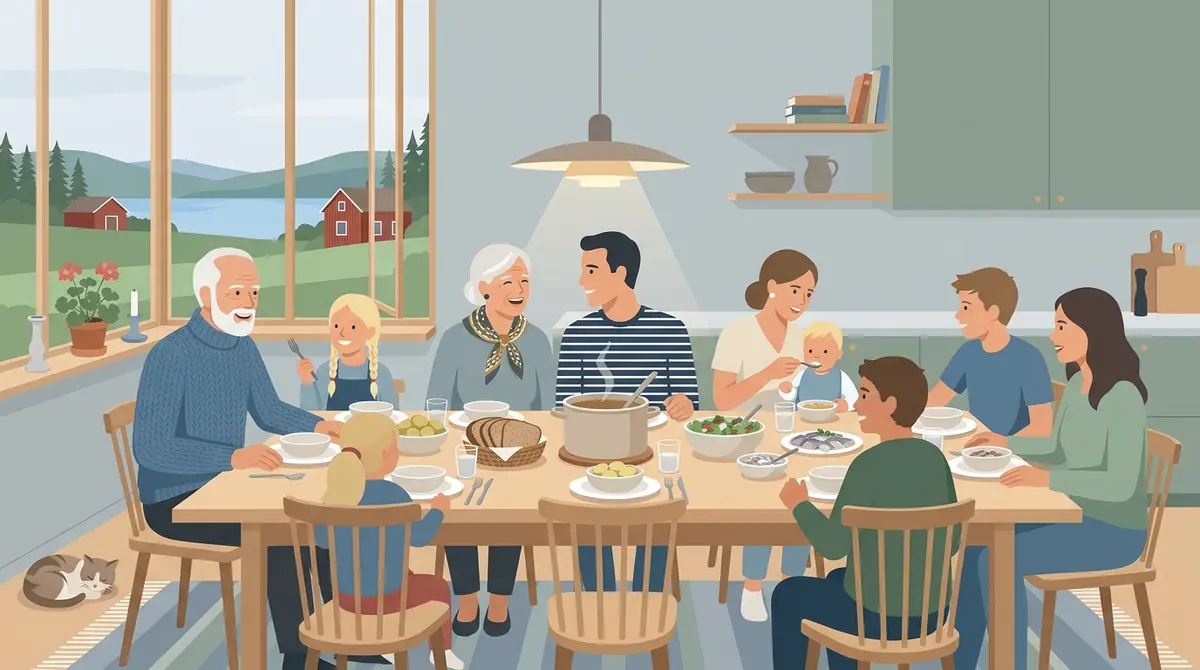
When you first start talking to Swedes about their relatives, you might notice something fascinating: the Swedish language does not just have one word for "grandmother" or "uncle". Instead, Swedish builds family words like small puzzles that tell you exactly whose side of the family someone belongs to. Once you learn the simple blueprint behind these words, you will never mix up your grandparents or your in-laws again.
The genius logic of Swedish grandparents
In English, the word "grandmother" leaves you guessing: is she on your mother's side or your father's side? Swedish solves this puzzle by sticking the words for mother (mor) and father (far) together.
Look at how clear and logical this is:
- mormor (mother's mother): grandmother on your mum's side
- morfar (mother's father): grandfather on your mum's side
- farmor (father's mother): grandmother on your dad's side
- farfar (father's father): grandfather on your dad's side
For everyday speech, Swedes use mamma (mum) and pappa (dad) when talking to their parents. But when referring to grandparents, the compound system stays: Jag ska fika med min mormor i dag (I am having fika with my maternal grandmother today).
What if you want to say "grandparents" as a collective group? You simply combine the two sides: morföräldrar (maternal grandparents) or farföräldrar (paternal grandparents). If you mean all four grandparents without specifying, you can say mor- och farföräldrar.
Aunts, uncles, and siblings
The same pattern works for aunts and uncles. Swedish creates precise titles based on who is related to whom:
- moster (short for mors syster): maternal aunt
- morbror (mother's brother): maternal uncle
- faster (short for fars syster): paternal aunt
- farbror (father's brother): paternal uncle
Notice how moster and faster are compressed forms of mor-syster and far-syster.
Here are two quick rules of thumb:
- If the word starts with mor-, it belongs to your mother's family.
- If the word starts with far-, it belongs to your father's family.
A common mistake for English speakers is looking for a Swedish word that means "aunt" in general. Swedish does not have a single neutral word for an aunt; you must choose moster or faster.
For brothers and sisters, Swedish has the collective noun ett syskon (a sibling). If someone asks you Har du syskon? (Do you have siblings?), you can answer: Ja, jag har en bror och en syster (Yes, I have a brother and a sister).
Modern Swedish relationships: sambo, särbo, and bonus
Swedish family life is known for being modern and practical, and the vocabulary reflects that. You will hear these words everywhere in Sweden:
- en sambo: a partner you live with without being married. This comes from sammanboende (living together). It is an official legal status in Sweden, and people remain sambo for decades, buy homes together, and raise children together.
- en särbo: a long-term romantic partner who lives in a separate home (sär- implies apart).
- en bonusfamilj: a blended family. Instead of using words with historical baggage like styvmor (stepmother), modern Swedish uses the positive word bonus: en bonusmamma (a stepmother), en bonuspappa (a stepfather), and ett bonusbarn (a stepchild).
Essential Swedish family vocabulary
| Swedish | English | Example |
|---|---|---|
| en familj | a family | Jag älskar min familj. (I love my family.) |
| föräldrar | parents | Mina föräldrar bor i Göteborg. (My parents live in Gothenburg.) |
| ett barn | a child | De har två barn. (They have two children.) |
| ett syskon | a sibling | Jag har tre syskon. (I have three siblings.) |
| en mormor | maternal grandmother | Min mormor bakar jättegoda bullar. (My maternal grandmother bakes delicious buns.) |
| en farfar | paternal grandfather | Farfar fyller 80 år på lördag. (Grandpa turns 80 on Saturday.) |
| en faster | paternal aunt | Vi hälsar på faster Karin. (We are visiting Aunt Karin.) |
| en morbror | maternal uncle | Min morbror är lärare. (My maternal uncle is a teacher.) |
| en sambo | cohabiting partner | Min sambo och jag letar efter en lägenhet. (My partner and I are looking for an flat.) |
| en bonuspappa | a stepfather | Min bonuspappa heter Erik. (My stepdad's name is Erik.) |
Family in Swedish everyday life
In Sweden, family relationships are informal and egalitarian. Children usually call their parents mamma and pappa, and everyone calls their aunts, uncles, and grandparents by their first names or by words like farmor and morfar.
You will also notice that being a sambo is completely equal in social respect to being married. When meeting colleagues on Monday morning, Swedes will casually say: Min sambo och jag åkte till stugan i helgen (My partner and I went to the cabin this weekend).
Blended families are also very common and well-supported in Swedish culture. There is even a hit Swedish comedy-drama series titled Bonusfamiljen (The Bonus Family) that explores the joys and chaos of co-parenting and modern family logistics.
Quick practice
Test your knowledge with these three short exercises.
- Your mother's brother is visiting you. What is he called in Swedish?
- Translate this sentence to English: Min sambo har två syskon.
- Choose the right word: Your dad's mother is your (mormor / farmor).
Answers
- morbror (or min morbror)
- "My partner (cohabitant) has two siblings."
- farmor
Practise this with Kielo
Try introducing your own family tree in your next Kielo conversation. Your daily plan will help you review words like mormor, syskon, and sambo until they feel completely natural.
Start your next chat by telling Kielo: Min familj är ganska stor! (My family is quite big!)
- Learn Swedish
- Swedish Vocabulary
- Swedish Family
- A1 Swedish
- Swedish Culture
Practise this Swedish with Kielo
AI conversations, short articles at your level and exercises built around your mistakes.
Download Kielo