
Kan jag få: How to Order Politely in Swedish
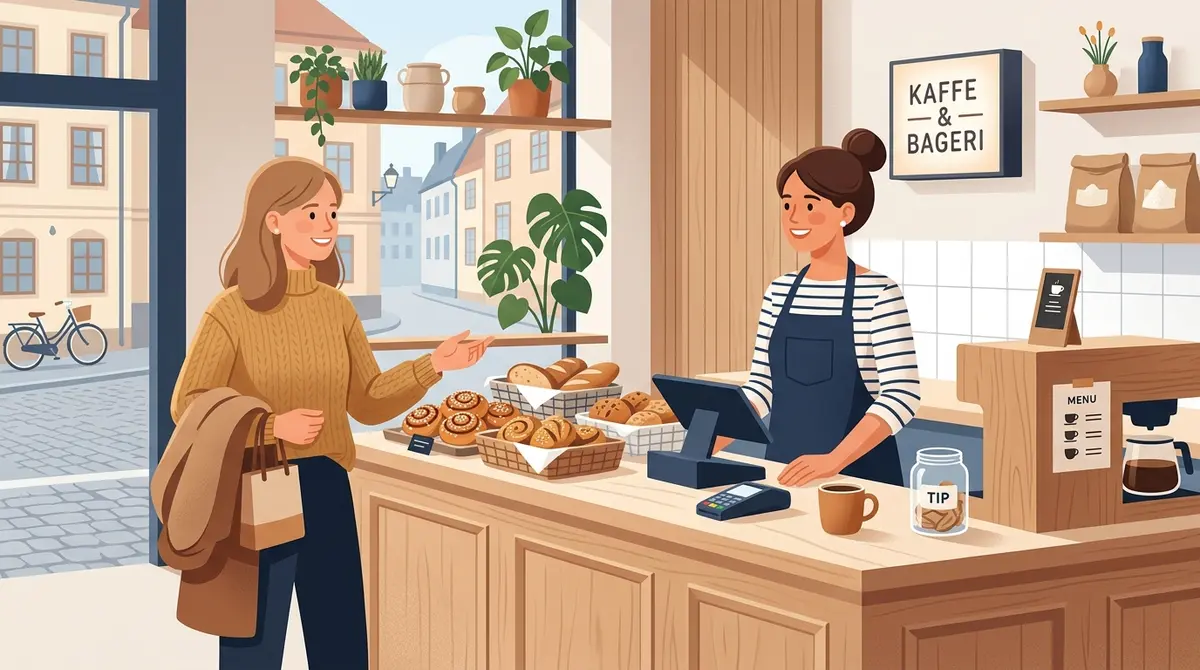
When you walk into a café in Stockholm or a bakery in Gothenburg, you might wonder how to say "please". English speakers often look for a direct word-for-word translation like "please can I have a coffee". But Swedish handles politeness differently: there is no single word that matches the English "please" at the start of a sentence. Instead, Swedish relies on friendly tone and one indispensable pattern: Kan jag få... (Can I have...). Mastering this simple structure lets you order drinks, pastries, lunch, and groceries with ease.
How to use Kan jag få to order anything
The phrase Kan jag få... literally translates to "Can I receive..." or "Can I get...". It consists of three short words:
- kan (can)
- jag (I)
- få (get / receive)
To order, simply put what you want right after få, and add tack (thanks / please) at the end:
- Kan jag få en kaffe, tack? (Can I have a coffee, please?)
- Kan jag få en kanelbulle? (Can I have a cinnamon bun?)
- Kan jag få notan, tack? (Can I have the bill, please?)
- Kan jag få ett glas vatten? (Can I have a glass of water?)
Adding tack at the end softens the request and does the work of "please" in English.
Common mistake to avoid: English speakers often translate "Can I have" as Kan jag ha. In Swedish, ha means "to possess" or "to hold", while få means "to receive". Saying Kan jag ha en kaffe sounds odd to a Swede. Always use få when you are asking someone to hand or serve you something. Another trap is using snälla (kind / please). While snälla does mean "please", it is used for begging or pleading—such as a child asking for ice cream—not for buying a cappuccino!
Two more natural ways to order: Jag tar and Skulle jag kunna få
While Kan jag få... is the most versatile phrase, you will hear locals use two other natural patterns:
1. Jag tar... / Jag tar gärna... (I'll take... / I'd love...)
When you step up to a lunch counter or a bar, you can state your choice directly. Adding the little adverb gärna (gladly / with pleasure) makes it warm and polite:
- Jag tar en kopp te, tack. (I'll take a cup of tea, thanks.)
- Jag tar gärna dagens lunch. (I'd like today's lunch special, please.)
- Jag tar en kardemummabulle. (I'll take a cardamom bun.)
2. Skulle jag kunna få...? (Could I possibly have...?)
If you want an extra polite or gentle tone—for example, if you are asking the server for an extra fork or asking to swap an ingredient—use the conditional form:
- Skulle jag kunna få lite mer mjölk? (Could I possibly have a little more milk?)
- Skulle vi kunna få sitta där borta? (Could we sit over there?)
What the server will ask you
Ordering is a two-way street. Once you say what you want, the person behind the counter will usually ask a couple of quick follow-up questions:
- För här eller att ta med? (For here or to take away?)
You can reply: För här, tack (For here, please) or Att ta med, tack (To take away, please). - Något mer? (Anything else?)
You can reply: Nej, det var bra så, tack. (No, that's all, thanks.) - Vill du ha kvitto? (Would you like a receipt?)
You can reply: Nej tack, det behövs inte. (No thanks, that's not needed.) or Ja tack! (Yes, please!)
Useful phrases for ordering and paying
Here are the most common words and phrases you will need whenever you buy food or drinks in Sweden:
| Swedish | English | Example |
|---|---|---|
| Kan jag få...? | Can I have...? | Kan jag få en kaffe med mjölk? (Can I have a coffee with milk?) |
| Jag tar gärna... | I'd love / I'll take... | Jag tar gärna en räkmacka. (I'll gladly take a shrimp sandwich.) |
| För här | For here / Eat in | För här, tack. (For here, thanks.) |
| Att ta med | To take away / Takeout | En latte att ta med, tack. (A latte to take away, please.) |
| Det var bra så | That's all / That's everything | Det var bra så, tack! (That will be all, thanks!) |
| Kan vi få notan? | Can we have the bill? | Ursäkta, kan vi få notan? (Excuse me, can we have the bill?) |
| Betalar ni ihop eller var för sig? | Are you paying together or separately? | Vi betalar var för sig. (We are paying separately.) |
| Kort eller kontant? | Card or cash? | Jag betalar med kort. (I'm paying by card.) |
| Smaklig måltid! | Enjoy your meal! | Smaklig måltid! – Tack så mycket! (Enjoy your meal! – Thank you very much!) |
How ordering works in real life in Sweden
Swedish society is known for being informal and egalitarian. You do not need to use formal titles or pronouns. Staff will address you with du (you), and you should address them with du as well. A simple Hej! (Hi!) when you reach the counter is the expected greeting.
Sweden is also practically a cashless country (ett kontantlöst samhälle). Almost all cafés, food trucks, and bakeries prefer card or mobile payments. When it is time to pay, the cashier will turn the card machine toward you and might say: Varsågod och slå koden (Please go ahead and enter your PIN) or Du kan blippa här (You can tap here).
Another handy tip: at lunch spots and cafés, tap water (kranvatten) is almost always free. You often do not even need to order it; look around for a self-service station near the counter with glasses, a water tap, cutlery (bestick), and paper napkins (servetter).
Quick practice
Test your knowledge with these three short exercises.
1. Fill in the blank
Complete the sentence to ask for a glass of water:
"Kan jag ______ ett glas vatten, tack?"
2. Choose the natural reply
The barista asks: För här eller att ta med? You want to drink your coffee in the café. What do you say?
A) Det var bra så.
B) För här, tack.
C) Jag tar kvitto.
3. Translate to Swedish
Translate this sentence into Swedish:
"I'll gladly take a cinnamon bun, please."
Answers
- få (Remember: use få, never ha).
- B (För här, tack).
- Jag tar gärna en kanelbulle, tack. (Or: Kan jag få en kanelbulle, tack?)
Practise this with Kielo
You can practise ordering drinks and bakery treats in a natural Kielo conversation right on your phone. Add these café phrases to your daily review plan so you can recall them effortlessly when you step up to the counter. Next time you visit a Swedish bakery, smile and say: Kan jag få en kaffe och en kanelbulle, tack?
- Learn Swedish
- Everyday Conversations
- Swedish Vocabulary
- Ordering Food
- Swedish Culture
Practise this Swedish with Kielo
AI conversations, short articles at your level and exercises built around your mistakes.
Download Kielo