
Swedish Days of the Week: På måndag or I måndags?
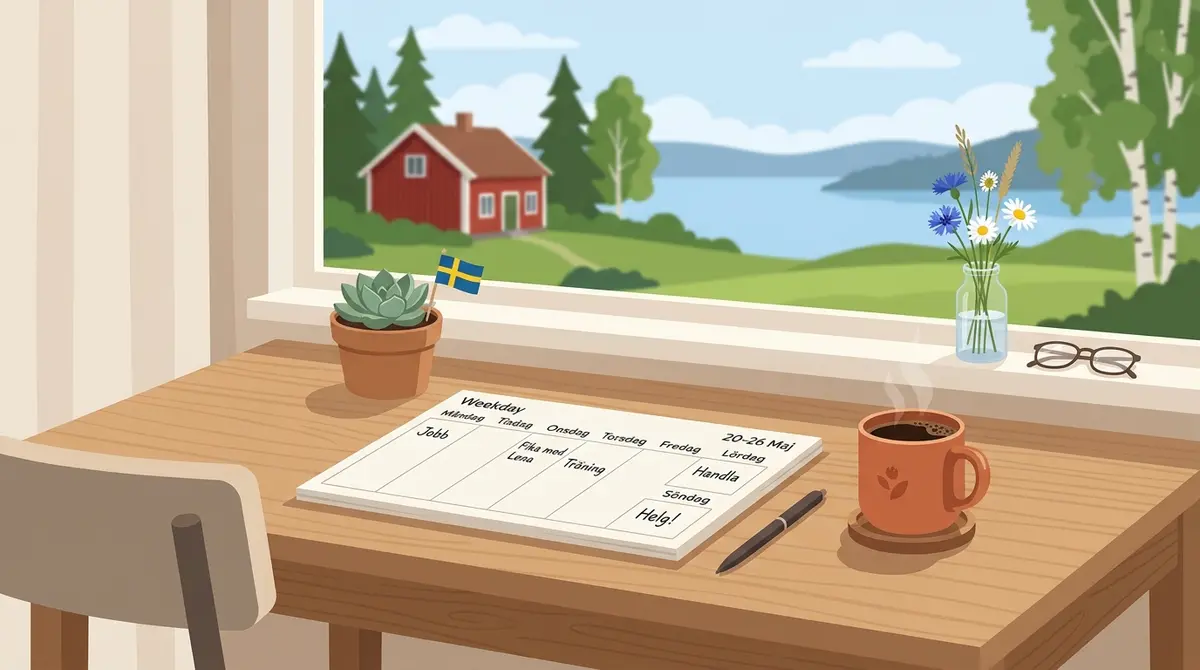
Making plans in a new language can feel like a minefield. You want to ask a colleague to grab coffee, or tell a friend what you did two days ago, but you hesitate: is it på måndag or i måndags? In English, you simply say "on Monday" or "last Monday." Swedish uses clever little preposition patterns to signal past, future, and regular habits. Once you see the pattern, talking about your schedule becomes second nature.
The Seven Days: Måndag to Söndag
First, let's meet the days of the week in Swedish. One important spelling rule to remember: unlike in English, Swedish days do not start with a capital letter unless they begin a sentence.
- måndag (Monday)
- tisdag (Tuesday)
- onsdag (Wednesday)
- torsdag (Thursday)
- fredag (Friday)
- lördag (Saturday)
- söndag (Sunday)
Most days end in -dag (day), which in casual spoken Swedish is often pronounced softly, sounding almost like "da." You will hear Swedes say månda, tisda, and onsda in everyday chats.
Past, Future, or Habit? The Preposition Secret
Here is where many learners stumble. In Swedish, the preposition you choose tells the listener whether you mean last week, this coming week, or every single week.
1. The Future: På + day (singular)
When you talk about an event happening on the coming day, use på (on) followed by the basic singular form of the day:
- Vi ses på fredag. (See you on Friday.)
- Vad ska du göra på lördag? (What are you going to do on Saturday?)
2. The Past: I + day + -s
When you talk about something that happened on the most recent past day, use i (in/on) and add an -s to the end of the day:
- Jag tränade i tisdags. (I worked out on Tuesday / this past Tuesday.)
- I fredags fikade vi. (Last Friday we had coffee.)
Notice that the -s is essential here. Saying på tisdag means the upcoming Tuesday, but i tisdags points strictly to the past.
3. Regular Habits: På + day + -ar
When something happens every week as a routine, use på followed by the plural form of the day, which ends in -ar:
- Jag simmar på måndagar. (I swim on Mondays.)
- Vi äter tacos på fredagar. (We eat tacos on Fridays.)
Watch Your Word Order with Time Words
When you place a time phrase at the start of your sentence, remember Sweden's golden grammar rule: the verb comes second. Check our guide on the Swedish V2 Rule: Master Basic Word Order if you need a quick refresher.
Compare these two sentences:
- Jag jobbade i måndags. (I worked on Monday.)
- I måndags jobbade jag. (On Monday I worked.)
Both are completely correct, but if you start with i måndags, the verb jobbade must come right after it, pushing the pronoun jag into third position. Combining this with what you know about telling time in Swedish will make your calendar talk sound remarkably natural.
Essential Time Phrases for the Week
Here is a quick reference table of essential vocabulary to build your weekly plans:
| Swedish | English | Example |
|---|---|---|
| en vardag | a weekday | Det är svårt att stiga upp på en vardag. (It is hard to get up on a weekday.) |
| en helg | a weekend | Trevlig helg! (Have a nice weekend!) |
| i helgen | this weekend / over the weekend | Vad ska du göra i helgen? (What are you doing this weekend?) |
| i helgs (rarely used; say: förra helgen) | last weekend | Vi vilade förra helgen. (We rested last weekend.) |
| i förrgår | the day before yesterday | Jag köpte boken i förrgår. (I bought the book the day before yesterday.) |
| i går / igår | yesterday | Hon ringde mig igår. (She called me yesterday.) |
| i dag / idag | today | Det är vackert väder idag. (It is nice weather today.) |
| i morgon / imorgon | tomorrow | Vi har ett möte imorgon. (We have a meeting tomorrow.) |
| i övermorgon | the day after tomorrow | Tåget går i övermorgon. (The train leaves the day after tomorrow.) |
How Swedes Talk About the Week in Real Life
In Sweden, life is strictly divided between vardag (weekday work life) and helg (weekend freedom). On Friday afternoons, workplaces clear out with cheerful shouts of Trevlig helg! (Have a nice weekend!).
Another unique Swedish cultural quirk is the obsession with veckonummer (week numbers). Swedes rarely say "let's schedule the project launch for the second week of March." Instead, you will routinely hear: Vi tar det i vecka 11 (We will do it in week 11) or Jag har semester vecka 28 (I have vacation in week 28). If you work or study in Sweden, download a calendar app that displays week numbers—it will save you endless confusion!
And of course, weekdays bring their own comforting rituals. After a long week, Friday evenings are reserved for cosy downtime at home, while coffee breaks with colleagues, or a proper fika, keep everyone energized Monday through Thursday.
Quick Practice
Fill in the blanks with the correct form: på lördag, i lördags, or på lördagar.
- Vi gick på bio ________. (We went to the cinema last Saturday.)
- Jag äter alltid godis ________. (I always eat sweets on Saturdays.)
- Vill du fika ________? (Do you want to have a coffee this coming Saturday?)
Answers
- i lördags (past event)
- på lördagar (habitual routine)
- på lördag (upcoming event)
Practise this with Kielo
Try booking an imaginary dinner or reviewing your past week during your next Swedish practice session. In Kielo, you can chat with your AI tutor about your weekly routine and see these prepositions turn up in your personalized review cards. Try saying this out loud right now: Vad ska du göra på fredag?
- Learn Swedish
- Swedish Vocabulary
- Time and Calendar
- Swedish Grammar
- A1 Swedish
- A2 Swedish
Practise this Swedish with Kielo
AI conversations, short articles at your level and exercises built around your mistakes.
Download Kielo