
Aukioloajat: Read Finnish Opening Hours Signs
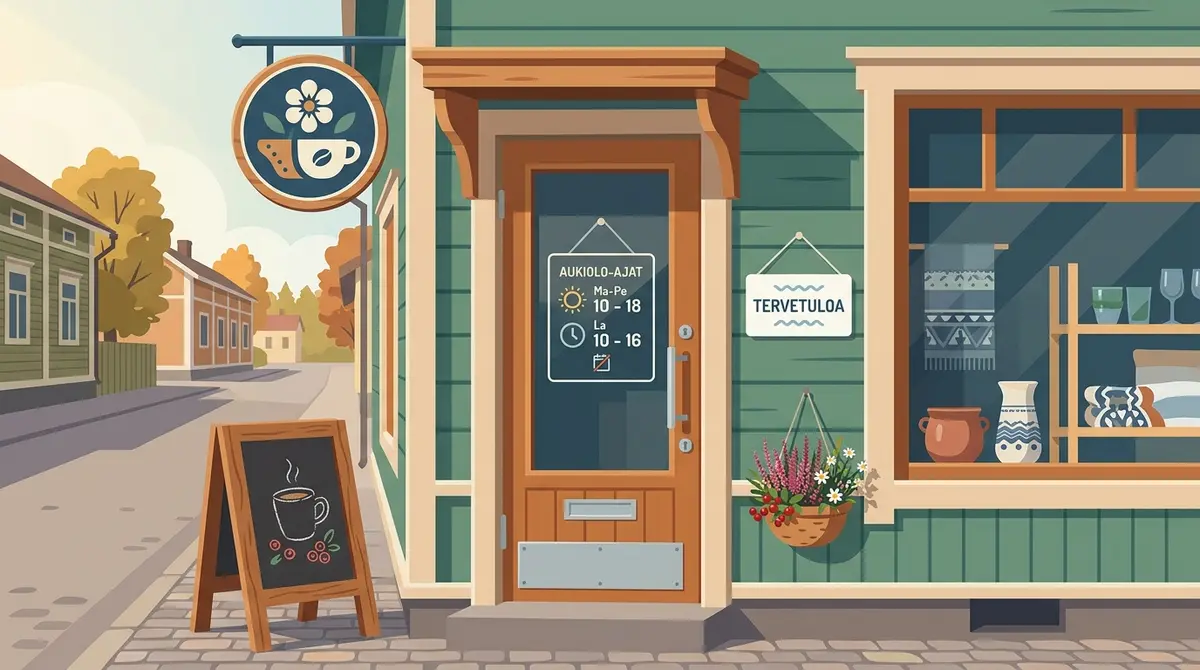
You walk up to a warm bakery or a quiet local library on a chilly November morning, reach for the door handle, and it doesn't budge. You look at the glass and see a grid of numbers, tiny Finnish words, and abbreviations. Understanding aukioloajat (opening hours) is one of the most useful daily skills you can learn in Finland. With a few key terms, you will always know whether a place is ready for you or when to come back.
The Basic Grid: Days, Open, and Closed
Most Finnish shop fronts and service desks display their hours in a standard three-line format. Even when the names of the days are not written in full, you will recognize the layout immediately:
- ma–pe 8–20 (Monday to Friday, 8:00 to 20:00)
- la 10–18 (Saturday, 10:00 to 18:00)
- su 12–16 (Sunday, 12:00 to 16:00)
Finnish uses two-letter abbreviations for days of the week: ma (maanantai, Monday), ti (tiistai, Tuesday), ke (keskiviikko, Wednesday), to (torstai, Thursday), pe (perjantai, Friday), la (lauantai, Saturday), and su (sunnuntai, Sunday). If you want a refresher on the full words, take a look at our guide to Maanantaina: How to Use Finnish Days of the Week.
Next to these times, you will often see status words. The most common pair is avoinna (open) and suljettu (closed). In spoken Finnish, people often say auki (open) and kiinni (closed), but signs on glass doors almost always use avoinna and suljettu.
A common mistake for beginners is confusing suljettu with "subject" or "suggested." Remember: if a door says suljettu, keep your mittens on, because nobody is inside to serve you!
Arkisin, Pyhänä, and Holiday Hours
Finnish doors often use special adverbs instead of listing every weekday one by one. Here are the three most important words to spot:
- arkisin (on weekdays). This word comes from arki (everyday life / weekday). When a sign says arkisin 7–19, it means Monday through Friday (and sometimes Saturday morning in older legal contexts, though modern shops usually specify Saturday separately).
- lauantaisin (on Saturdays) and sunnuntaisin (on Sundays). Notice that -isin ending? It means "regularly on that day."
- pyhäisin (on Sundays and public holidays). This comes from pyhä (holy / holiday). If a museum is open pyhäisin 12–16, that applies to normal Sundays as well as official church or national holidays.
When holidays approach, you will often see a paper note taped beside the main schedule marked poikkeusaukioloajat (exceptional opening hours). Finland takes holidays seriously, and stores often close early on an eve, marked as aattona (on the eve). For example, jouluaattona means "on Christmas Eve."
Push, Pull, and Finding the Right Door
Once you know the place is open, you still have to get through the door. Finnish handles can be confusing, and pulling a push door is a classic rite of passage. Look for these two small action words:
- vedä (pull)
- työnnä (push)
A handy memory trick: vedä starts with v, just like "towards" (vastaan). Työnnä has two dots over the ö, like two hands pushing outward.
If the door still refuses to move, look for another sign nearby:
- käynti toisesta ovesta (entry through the other door)
- sisäänkäynti (entrance)
- uloskäynti (exit)
- henkilökunnalle (staff only)
Essential Door and Schedule Words
| Finnish | English | Example |
|---|---|---|
| aukioloajat | opening hours | Kirjaston aukioloajat muuttuvat. (The library's opening hours change.) |
| avoinna | open | Kahvila on avoinna tänään. (The café is open today.) |
| suljettu | closed | Maanantaisin museo on suljettu. (On Mondays the museum is closed.) |
| arkisin | on weekdays | Olemme avoinna arkisin kello kahdeksasta alkaen. (We are open on weekdays starting from eight o'clock.) |
| vedä | pull | Vedä ovesta varovasti. (Pull the door gently.) |
| työnnä | push | Työnnä ovea, älä vedä. (Push the door, do not pull.) |
| sisäänkäynti | entrance | Pääsisäänkäynti on remontissa. (The main entrance is under renovation.) |
| klo (short for kello) | at / o'clock | Kauppa aukeaa klo 9. (The shop opens at 9:00.) |
Opening Hours in Finnish Everyday Life
Finnish society values precision and punctuality. If a shop sign says avoinna klo 9.00, the automatic doors will click unlocked at precisely 09:00:00, not a minute earlier. In deep winter, when it is freezing outside in the pakkanen, arriving right on time saves you from waiting out in the cold.
Large grocery stores in major cities are increasingly open 24h or vuorokauden ympäri (around the clock). However, smaller specialty shops, post offices, pharmacies (apteekki), and health centres (terveysasema) keep strict daytime hours and often close earlier on Fridays.
Keep an eye out for self-service hours, especially in public libraries. You might see a sign that reads omatoimiaika (self-service hours). During these times, the building is open and you can borrow books using your library card and PIN, even though the staff desks are unstaffed.
Quick Practice
Read these three signs and choose the correct answer:
-
A door sign reads: Suljettu ma–ti. Ke–su 11–18. Can you visit on Tuesday afternoon?
- Answer: No. The door clearly states suljettu ma–ti (closed Monday–Tuesday).
-
You see a sign on an office door: Vedä. Do you push or pull?
- Answer: You pull! (Työnnä means push.)
-
A pharmacy notice says: Poikkeusaukioloajat: la 10–14, su suljettu. What happens on Sunday?
- Answer: The pharmacy is closed all day on Sunday (su suljettu).
Practise This with Kielo
Next time you explore a Finnish town or check a shop website, test yourself on the numbers, abbreviations, and door signs. You can practice recognizing these time expressions in your interactive chats on Kielo and add them to your personalized review plan. Keep this phrase in mind on your next errand: Kahvila on avoinna arkisin kello kahdeksasta alkaen.
- Learn Finnish
- Reading Signs and Labels
- Finnish Vocabulary
- Everyday Finnish
- Aukioloajat
Practise this Finnish with Kielo
AI conversations, short articles at your level and exercises built around your mistakes.
Download Kielo