
Perhe: How to Talk About Your Family in Finnish
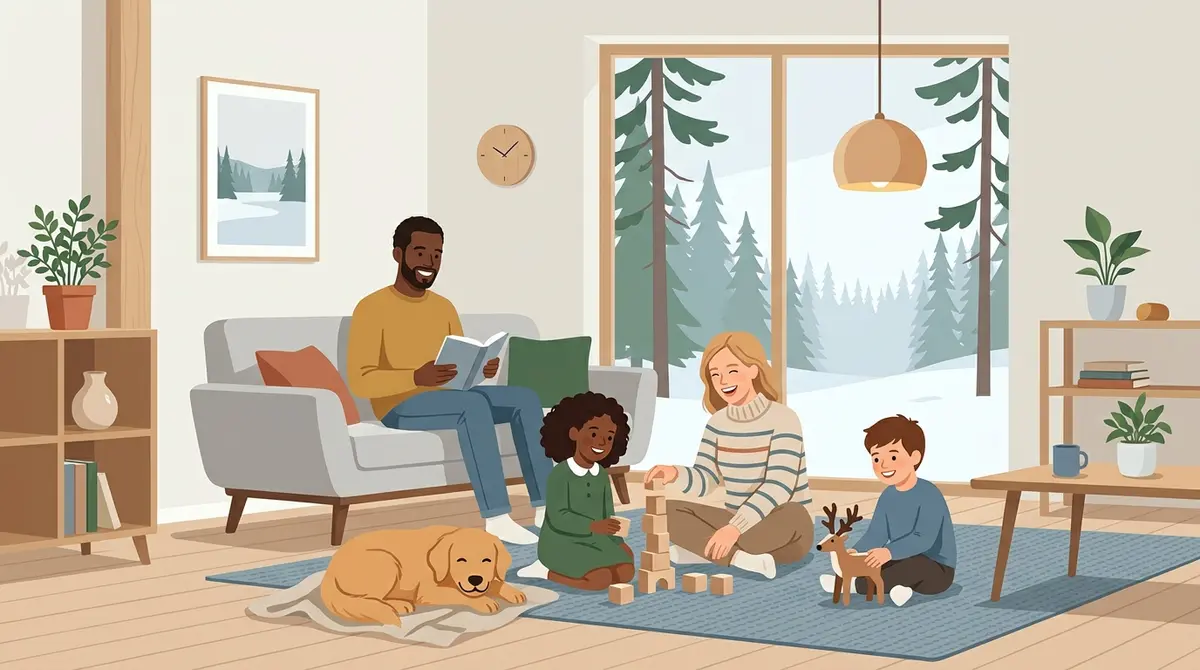
When you meet new people in Finland, the conversation often turns to home life. Coworkers at lunch or classmates at language school might ask if you have siblings or children. Talking about your perhe (family) is one of the quickest ways to connect with others.
Finnish family words are delightfully straightforward once you spot a few simple patterns. Let’s explore the essential vocabulary and the sentence structures you need to describe your loved ones with confidence.
Parents and Children: The Immediate Circle
To talk about your immediate family, start with the core words. For parents, Finns use vanhemmat (parents). In daily speech, you will hear both standard and affectionate terms:
- äiti (mother, mum), or more affectionately mamma / mami
- isä (father, dad), or more affectionately isi / iskä
- lapsi (child)
- lapset (children)
When Finns talk about having children, you will often hear gender-specific words:
- poika (boy, son)
- tytär (daughter)
One child is lapsi. Lapset means the children (plural), but after a number you use the singular partitive: kaksi lasta.
When stating that you have family members, remember to use the "have" structure. In Finnish, you say Minulla on... (I have...), not Minä olen. If you tend to mix the two up, read our guide Minulla on or Minä olen?.
If you have one child, the word stays in the basic form: Minulla on poika (I have a son). But if you have more than one, use a number followed by the singular partitive: Minulla on kaksi poikaa (I have two sons) or Minulla on kolme lasta (I have three children).
Sibling Secrets: Big and Small
The general word for a sibling is sisarus (sibling), and the plural is sisarukset (siblings). If you want to ask someone if they have siblings, you can ask: Onko sinulla sisaruksia? (Do you have siblings?).
To answer, you need the words for brothers and sisters:
- veli (brother)
- sisko (sister)
Finnish does not have separate words like "elder brother" or "younger sister". Instead, you simply add iso- (big) or pikku- (little) right to the front of the word:
- isoveli (older brother)
- pikkuveli (younger brother)
- isosisko (older sister)
- pikkusisko (younger sister)
Here is a quick sentence you can use right away: Minulla on yksi isoveli ja kaksi pikkusiskoa (I have one older brother and two younger sisters). If you grew up as an only child, say Olen ainoa lapsi (I am an only child).
Grandparents and Extended Family
When your family circle widens, compound words make Finnish vocabulary surprisingly easy to learn. Finns use compound words for grandparents:
- isovanhemmat (grandparents)
- isoäiti (grandmother)
- isoisä (grandfather)
In real life, Finnish grandchildren rarely say the formal word isoäiti. Instead, you will hear cosy spoken words like mummo, mummi, or muori for grandma, and ukki, vaari, or pappa for grandpa. Different families have their own favourite terms!
For other relatives, look at sukulaiset (relatives):
- täti (aunt)
- setä (paternal uncle, your father's brother)
- eno (maternal uncle, your mother's brother)
- serkku (cousin)
Notice that Finnish has two different words for "uncle". A setä is your father’s brother, while an eno is your mother’s brother. It is an old distinction that remains very much alive in modern Finnish.
If you want to talk about your partner or spouse as part of your family, check out our guide on Kumppani vai Puoliso? to pick the right term.
Essential Family Words
Here is a practical summary of words to describe your family:
| Finnish | English | Example |
|---|---|---|
| perhe | family | Minun perheeni asuu Espoossa. (My family lives in Espoo.) |
| vanhemmat | parents | Vanhempani ovat eläkkeellä. (My parents are retired.) |
| isoveli | older brother | Isoveljeni soittaa kitaraa. (My older brother plays the guitar.) |
| pikkusisko | younger sister | Pikkusiskoni opiskelee lukiossa. (My younger sister studies in upper secondary school.) |
| kaksoset | twins | He ovat kaksoset. (They are twins.) |
| lapsenlapsi | grandchild | Isoäidillä on viisi lapsenlasta. (Grandmother has five grandchildren.) |
| serkku | cousin | Serkkuni asuu Oulussa. (My cousin lives in Oulu.) |
| lemmikki | pet | Kissa on meidän perheen lemmikki. (The cat is our family pet.) |
Family in Finnish Daily Life
In Finnish society, families tend to be relatively small, with one or two children being the most common. Work-life balance is strongly protected by law, meaning many parents finish work around 16:00 to pick up their children from day care (päiväkoti) or school.
Parental leave is also very common. You will frequently see Finnish fathers pushing prams (lastenvaunut) through snowy parks or sitting in cafés during the workday.
When visiting a Finnish home, you might notice that pets are treated like full family members. If you want to include your furry friends when describing your household, you can say Meillä on koira (We have a dog) or Meillä on kissa (We have a cat).
Finns value modesty, so people rarely boast about their family members. A warm, honest sentence like Meillä on mukava arki (We have a nice everyday life) fits Finnish conversational style perfectly.
Quick Practice
Test what you have learned with these three quick exercises.
- Translate into Finnish: "I have one brother and one sister."
- Choose the right word: Your mother's brother is your (setä / eno).
- Fill in the blank: "Minulla on kaksi ______ (lapsi)."
Answers
- Minulla on yksi veli ja yksi sisko.
- eno (Remember: setä is your father's brother, eno is your mother's brother.)
- lasta (After numbers greater than one, use the singular partitive form: kaksi lasta.)
Practise This with Kielo
You can practise introducing your family members in a fun Kielo conversation and review words like isosisko and vanhemmat in your daily plan. Regular practice makes these everyday words feel completely natural. Try sharing: Minun perheeseeni kuuluu kolme ihmistä ja koira (My family includes three people and a dog).
- Learn Finnish
- Finnish Vocabulary
- Family and Relationships
- Finnish Grammar
- Beginner Finnish
Practise this Finnish with Kielo
AI conversations, short articles at your level and exercises built around your mistakes.
Download Kielo