
Crafting Clearer Sentences: A Guide to Finnish Adverbs
Crafting Clearer Sentences: A Beginner's Guide to Finnish Adverbs
Have you ever felt like your Finnish sentences are a bit… plain? You can convey the basic idea, but you miss that extra sparkle, the nuance that makes your communication truly engaging. This feeling is common for beginners, but it's exactly where Finnish adverbs, or adverbit, come to the rescue! Adverbs are the secret ingredient to add detail, express how, where, or when something happens, and ultimately, bring your Finnish to life. Mastering them will allow you to paint a much clearer picture with your words, making your conversations more precise and your understanding of Finnish richer.
The Building Blocks: What Are Finnish Adverbs?
In Finnish, just like in English, adverbs are words that modify verbs, adjectives, or other adverbs. They answer questions like "How?", "When?", "Where?", "How often?", or "To what extent?". For learners at the A1-A2 level, understanding the main types of adverbs – especially those of manner, place, and time – is a fantastic step toward crafting clearer sentences.
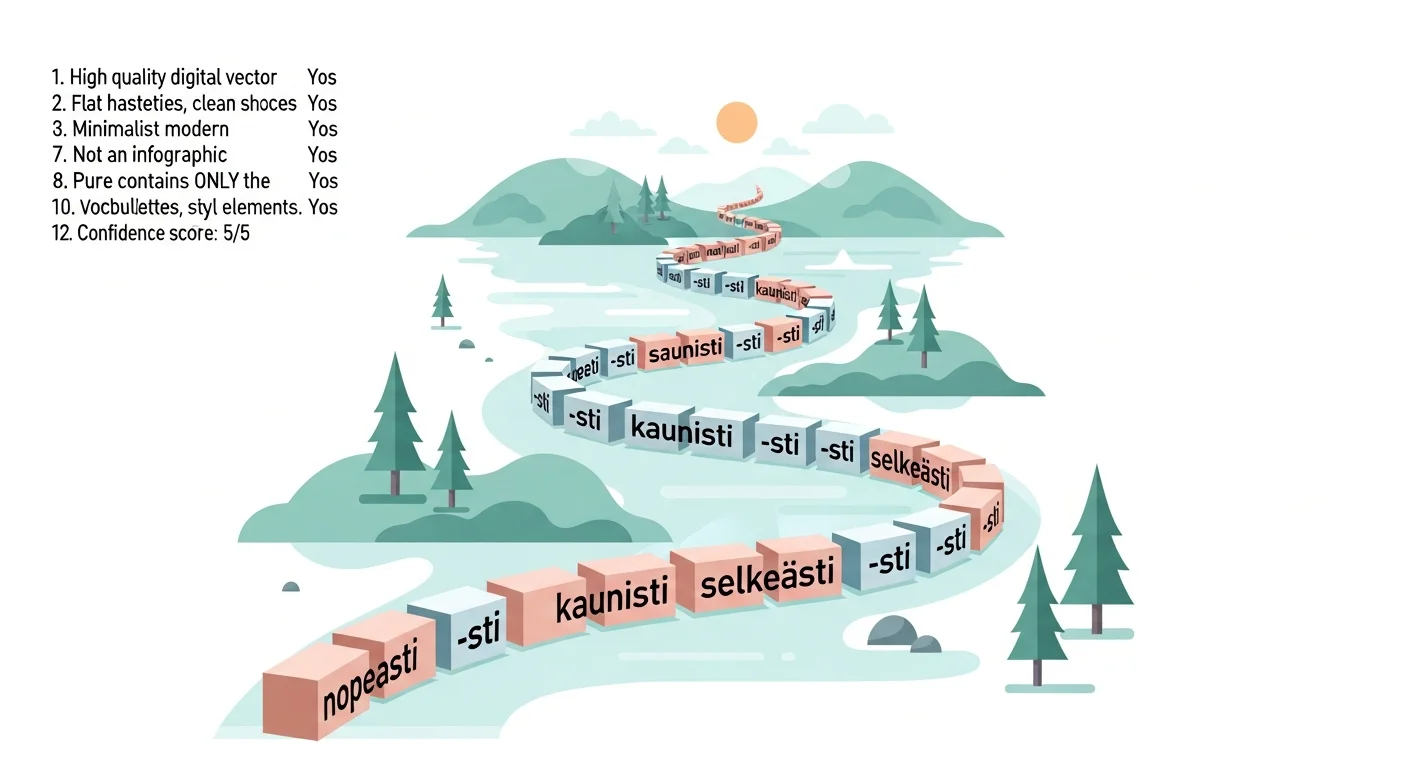
One of the most common ways to form adverbs of manner in Finnish is by adding the suffix -sti to the stem of an adjective. This is similar to adding "-ly" in English!
Let's look at some examples:
- nopea (fast) → nopeasti (quickly, fast)
- kaunis (beautiful) → kauniisti (beautifully)
- hidas (slow) → hitaasti (slowly)
- varovainen (careful) → varovasti (carefully)
These adverbs tell us how an action is performed. For instance, Hän puhuu nopeasti means "He speaks quickly." He laulavat kauniisti translates to "They sing beautifully." A useful memory trick is to think of the "-sti" ending as often conveying "in a... way." However, there's an important irregular adverb to note early on: hyvä (good) becomes hyvin (well), not hyvästi. Be careful, as hyvästi means "farewell" or "goodbye"!
Navigating Time and Space: Place and Time Adverbs
Beyond manner, adverbs are essential for indicating where and when something happens. Finnish features a distinct and logical system for place adverbs that often comes in a three-way set, indicating "at," "to," or "from" a location.
For example, with "here":
- täällä (here, at this place)
- tänne (to here)
- täältä (from here)
This pattern applies to other common place adverbs too, like siellä / sinne / sieltä (there / to there / from there). You'll encounter these frequently in everyday Finnish!
Time adverbs are also crucial for beginners, helping you contextualize events. Some common time adverbs include:
- nyt (now)
- aina (always)
- usein (often)
- joskus (sometimes)
- eilen (yesterday)
- huomenna (tomorrow)
Let's see them in action: Olen aina kiireinen (I am always busy). Käyn usein uimassa (I often go swimming). These fixed adverbs don't typically change their form and are important to memorize as whole words.
Key Phrases / Hyödyllisiä ilmauksia
Here are some practical sentences incorporating Finnish adverbs:
- Puhutko suomea sujuvasti? — Do you speak Finnish fluently?
- Tulen pian takaisin. — I'll be back soon.
- Asun täällä Suomessa. — I live here in Finland.
- Syön usein kalaruokaa. — I often eat fish.
- Hän ajaa varovasti. — He drives carefully.
- Olen aina iloinen nähdessäni sinut. — I am always happy to see you.
- Lapset leikkivät ulkona. — The children are playing outside.
Vocabulary / Sanasto
Expand your adverb knowledge with these essential words:
| Finnish | English | Example |
|---|---|---|
| nopeasti | quickly | Hän oppi nopeasti. — He learned quickly. |
| kauniisti | beautifully | Laulat kauniisti. — You sing beautifully. |
| täällä | here | Olen täällä. — I am here. |
| siellä | there | Mennäänkö sinne? — Shall we go there? |
| usein | often | Käyn usein kaupassa. — I often go to the shop. |
| aina | always | Aina kiireinen. — Always busy. |
| ulkona | outside | Tuulee ulkona. — It's windy outside. |
| nyt | now | Mitä teet nyt? — What are you doing now? |
| varovasti | carefully | Aja varovasti! — Drive carefully! |
| sujuvasti | fluently | Puhun sujuvasti suomea. — I speak Finnish fluently. |
🇫🇮 Cultural Context / Kulttuuritausta
Finns are known for their direct and clear communication, and adverbs play a significant role in achieving this precision. While English speakers might sometimes use many descriptive adjectives, Finns often rely on well-placed adverbs to convey subtle meanings and emphasize actions or states. For example, simply saying kiitos paljon (thanks a lot) uses the adverb paljon to add emphasis to your gratitude.
It’s worth noting that Finns generally appreciate when foreigners make an effort to speak their language, even if it's just a few words. Using adverbs correctly shows a deeper understanding and respect for the language's nuances, which can enhance your interactions. While English is widely spoken in Finland, especially by those under 60, trying out your Finnish skills, particularly with well-formed sentences using adverbs, will often be met with delighted reactions. Finnish, a Finno-Ugric language, is unique and grammatically distinct from its Nordic neighbors, making any attempt to speak it all the more commendable.
Quick Practice / Harjoitus
Test your newfound adverb knowledge with these quick exercises!
- Translate the following sentence into Finnish: "She sings beautifully."
- Fill in the blank with the correct Finnish adverb: Minä syön _______. (quickly)
- Choose the correct adverb to complete the sentence: Lapset leikkivät (täällä / eilen). (The children are playing here.)
- Answers:
- Hän laulaa kauniisti.
- Minä syön nopeasti.
- Lapset leikkivät täällä.
Conclusion
Congratulations! You've taken a significant step in Crafting Clearer Sentences: A Beginner's Guide to Finnish Adverbs. By integrating adverbs of manner, place, and time into your vocabulary, you're not just adding words; you're adding layers of meaning and precision to your Finnish communication. Keep practicing these adverbs in different contexts, listen for them in conversations, and try to incorporate them into your own speaking and writing. This continuous effort will solidify your understanding and move you closer to fluent, natural-sounding Finnish. Keep learning, keep experimenting, and enjoy the clarity your new adverbial skills bring!
References
- MyLanguages.org. Finnish Adverbs
- Elon.io. Adverbs in Finnish - Grammar
- Uusi kielemme. Finnish Adverb Types Overview - Adverbien tyypit
- Yle Kielikoulu. Yle Kielikoulu - a new website/app to learn Finnish
Ready to start learning?