
Beyond the Root: Navigating Finnish Verb Types A1-A2
Beyond the Root: Navigating Finnish Verb Types A1-A2
Tired of feeling lost when Finnish verbs change their shape? You're not alone! Finnish verbs, with their rich system of conjugation, can seem daunting at first. However, understanding "Beyond the Root: Navigating Finnish Verb Types for A1-A2 Learners" is one of the most powerful steps you can take in your language journey. It's the key to unlocking how actions, states, and ideas truly come to life in Finnish.
This practical guide will demystify the system, focusing on the most common verb types crucial for A1-A2 learners. By the end, you'll not only recognize the different verb types but also confidently conjugate them in the present tense, transforming your ability to communicate in real Finnish.
The Six Pillars: An Overview of Finnish Verb Types
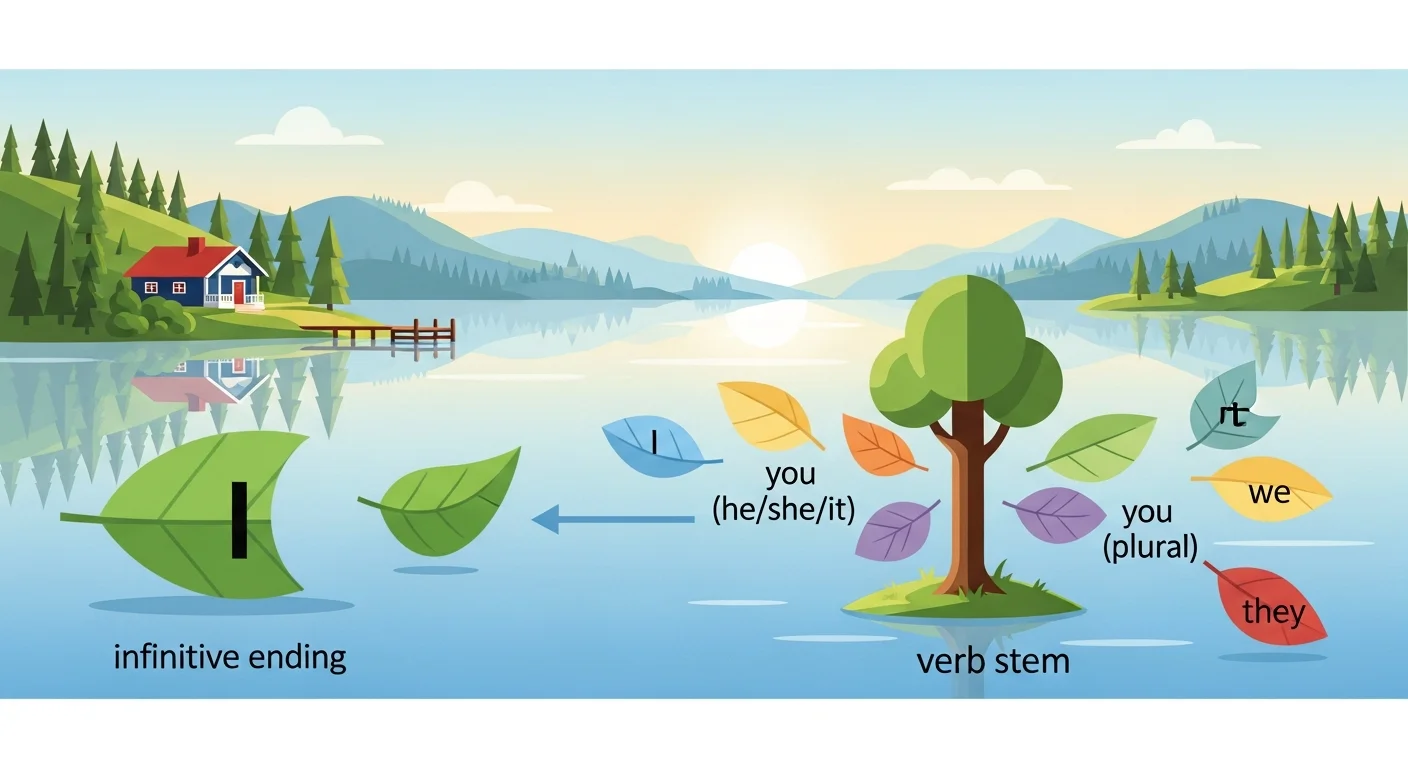
Finnish verbs are categorized into six main types, each following a predictable pattern for conjugation. While six might sound like a lot, the good news is that for A1-A2 learners, mastering Types 1, 2, and 3 will cover the vast majority of verbs you'll encounter in daily conversation. The classification is based on how the infinitive form (the "to + verb" form, like "to speak") ends, and how that ending changes to create the verb stem.
Let's begin with Verb Type 1, the most common and arguably the most foundational:
Verb Type 1: The Double-Vowel Powerhouse (-aa, -ea, -oa, -ua, -yä, -iä, etc.)
Type 1 verbs are easily recognizable because their infinitive form always ends in two vowels, where the first vowel is strong and the second is a or ä (depending on vowel harmony). Examples include puhua (to speak), lukea (to read), asua (to live), and ottaa (to take).
The rule for conjugating Type 1 verbs in the present tense is straightforward:
- Remove the final -a or -ä from the infinitive. This gives you the verb stem.
- Add the appropriate personal ending to this stem.
Let's take puhua (to speak) as our primary example:
| Person | Conjugation | English Translation |
|---|---|---|
| minä (I) | puhun | I speak |
| sinä (you, sg) | puhut | You speak |
| hän (he/she) | puhuu | He/She speaks |
| me (we) | puhumme | We speak |
| te (you, pl) | puhutte | You speak |
| he (they) | puhuvat | They speak |
Notice the vowel lengthening for hän (he/she) – a common feature in Finnish conjugation for Type 1 verbs. Also, observe how vowel harmony determines whether you use back vowels (a, o, u) or front vowels (ä, ö, y) in the endings. For puhua, which has u, we use back vowel endings. For lukea (to read), which has e, we use front vowel endings like luen, luet, lukee, luemme, luette, lukevat.
Diving Deeper: Type 2 and Type 3 Verbs
Once you're comfortable with Type 1, expanding your knowledge to Type 2 and Type 3 will significantly boost your conversational Finnish.
Verb Type 2: The -da/-dä Duo
These verbs end in -da or -dä. While less numerous than Type 1, they include essential verbs like syödä (to eat) and juoda (to drink). The general rule is to remove the -da or -dä ending and then add the personal endings. However, with Type 2, the 'd' often disappears in practice, and you're sometimes left with just the vowel before adding the personal ending.
Let's conjugate syödä (to eat):
| Person | Conjugation | English Translation |
|---|---|---|
| minä (I) | syön | I eat |
| sinä (you, sg) | syöt | You eat |
| hän (he/she) | syö | He/She eats |
| me (we) | syömme | We eat |
| te (you, pl) | syötte | You eat |
| he (they) | syövät | They eat |
Notice that hän (he/she) has no ending at all! This is a unique characteristic of Type 2 verbs. For juoda (to drink), you'd get juon, juot, juo, juomme, juotte, juovat.
Verb Type 3: The Consonant Cluster Connectors (-lla, -rra, -nna, -sta, -tä)
Type 3 verbs end in -lla, -rra, -nna, -sta, or -tä (a consonant cluster followed by a or ä). Key verbs in this category include mennä (to go), tulla (to come), and opiskella (to study).
The rule for Type 3 is:
- Remove the final -a or -ä.
- Add an -e- before the personal ending.
Let's conjugate mennä (to go):
| Person | Conjugation | English Translation |
|---|---|---|
| minä (I) | menen | I go |
| sinä (you, sg) | menet | You go |
| hän (he/she) | menee | He/She goes |
| me (we) | menemme | We go |
| te (you, pl) | menette | You go |
| he (they) | menevät | They go |
You can see the consistent -e- appearing before the personal endings. For tulla (to come), you'd get tulen, tulet, tulee, tulemme, tulette, tulevat.
While there are Types 4, 5, and 6, they are less common for A1-A2 proficiency. Understanding Types 1, 2, and 3 provides a strong foundation.
Key Phrases / Hyödyllisiä ilmauksia
Here are some phrases using the verb types we've learned:
- Mitä sinä teet? — What are you doing?
- Minä puhun suomea. — I speak Finnish.
- Hän lukee kirjaa. — He/She is reading a book.
- Me syömme lounasta. — We are eating lunch.
- He menevät kotiin. — They are going home.
- Tulen pian! — I'm coming soon!
- Me opiskelemme yhdessä. — We are studying together.
Vocabulary / Sanasto
| Finnish | English | Example |
|---|---|---|
| puhua | to speak | Minä puhun suomea. |
| lukea | to read | Hän lukee kirjaa. |
| syödä | to eat | Me syömme lounasta. |
| mennä | to go | Sinä menet kauppaan. |
| tulla | to come | He tulevat huomenna. |
| opiskella | to study | Minä opiskelen yliopistossa. |
| asua | to live | Me asumme Helsingissä. |
| juoda | to drink | Hän juo kahvia. |

🇫🇮 Cultural Context / Kulttuuritausta
In Finnish culture, clear and direct communication is often valued. Getting your verb conjugations correct is a significant step towards this clarity. While Finns are generally very forgiving of mistakes from learners, making an effort to use the correct verb forms demonstrates respect for the language and its intricacies. Don't be afraid to try! Even if you make a mistake, Finns will appreciate your effort to speak their beautiful language. Understanding the different verb types allows you to appreciate the underlying logic of Finnish grammar, which is remarkably consistent once you grasp the patterns. This consistency is a hallmark of the Finnish language and makes it incredibly rewarding to learn.
Quick Practice / Harjoitus
Test your newfound knowledge with these quick exercises!
- Conjugate the verb lukea (to read) for "minä" and "sinä" in the present tense.
- Minä ___________
- Sinä ___________
- Change the subject for "He syövät" (They eat) to "Minä".
- Minä ___________
- Fill in the blank with the correct form of mennä (to go):
- Me ___________ kotiin. (We are going home.)
(Answers: 1. Minä luen, Sinä luet; 2. Minä syön; 3. Me menemme kotiin)
Conclusion
Congratulations! You've taken a significant step "Beyond the Root: Navigating Finnish Verb Types for A1-A2 Learners." By understanding the basic patterns of Type 1, 2, and 3 verbs, you now have the tools to express yourself more clearly and confidently in Finnish. Remember, practice is key! Try to identify verb types when you read or listen to Finnish, and actively use them in your own sentences. The more you practice, the more these patterns will become second nature. Keep exploring, keep speaking, and enjoy the journey of mastering Finnish!
Related Topics
- Finnish Cases: Mastering Noun Endings
- Vowel Harmony: The Sound of Finnish
- Basic Finnish Sentence Structure
References
Ready to start learning?