
Finnish 'Olla' vs. 'Olla olemassa': Existence Explained

Finnish 'Olla' vs. 'Olla olemassa': Mastering Existence in Finnish
Are you ready to unravel one of the trickier parts of Finnish grammar? Understanding the nuances between olla (to be) and olla olemassa (to exist) is crucial for expressing yourself accurately and naturally in Finnish. This lesson will equip you with the knowledge and practical examples you need to confidently use these verbs of existence. Let's dive in!
Core Lesson Section 1
The verb olla is the most common way to say "to be" in Finnish. It's used to describe states of being, characteristics, and locations. Think of it like the English verb "to be" (am, is, are, was, were). However, olla olemassa carries a slightly different meaning: it specifically emphasizes existence or presence.
Here's a basic breakdown:
- Olla: To be (state of being, characteristic, location)
- Olla olemassa: To exist, to be present
Consider these examples:
- Minä olen opiskelija. — I am a student. (Olla describes a state of being)
- Hän on iloinen. — He/She is happy. (Olla describes a characteristic)
- Kirja on pöydällä. — The book is on the table. (Olla indicates location)
- Jumala on olemassa. — God exists. (Olla olemassa expresses existence)
- Onko täällä kahvilaa olemassa? — Is there a cafe here? (Olla olemassa questions existence)
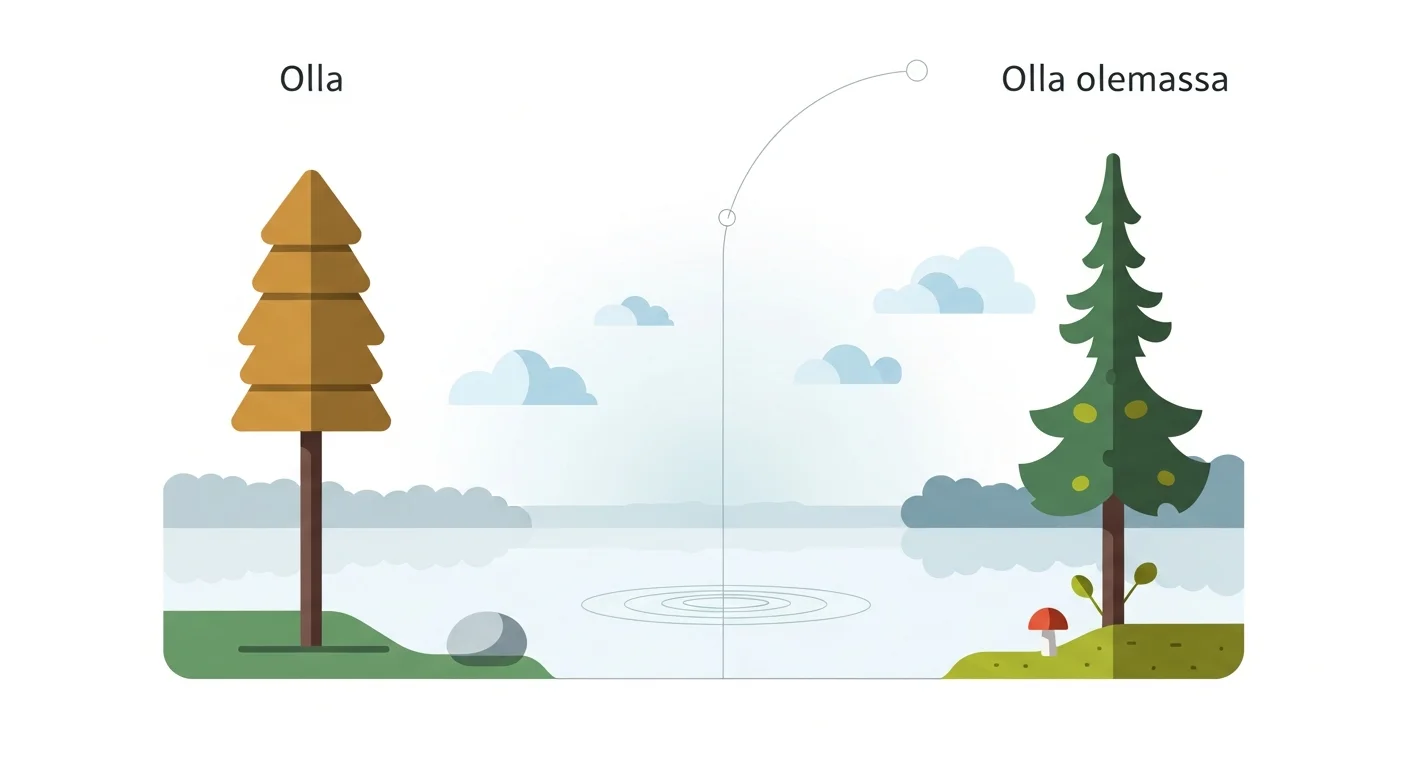
The key difference lies in the emphasis. Olla is the general "to be," while olla olemassa highlights the very fact of existence.
Core Lesson Section 2
Let's explore some more examples to solidify your understanding. Often, olla can be used where olla olemassa would also be grammatically correct, but the emphasis would change. For instance:
- Ravintola on. — The restaurant is (open/functioning/located here). (Olla implies the restaurant's general state or location)
- Ravintola on olemassa. — The restaurant exists (is a real establishment). (Olla olemassa stresses the restaurant's actual existence)
Think about a situation where someone is looking for a specific book. You might say:
-
Kirja on hyllyssä. — The book is on the shelf. (Simply stating the book's location) But, if someone doubts that the book even exists, you could say:
-
Kirja on olemassa! — The book does exist! (Emphasizing the book's presence)
Olla olemassa is also frequently used in existential or philosophical contexts, or when discussing abstract concepts.
Key Phrases / Hyödyllisiä ilmauksia
- Onko sinulla aikaa? — Do you have time? (Uses olla in an idiomatic expression)
- Minulla on nälkä. — I am hungry. (Another idiomatic expression with olla)
- Ei ole ongelmaa. — There is no problem. (Olla in a negative sentence)
- Elämä on ihanaa. — Life is wonderful. (Olla describing a state of being)
- Onko täällä vessoja olemassa? — Are there toilets here? (Olla olemassa inquiring about the presence of something)
- Maailmassa on paljon pahaa. - There is much evil in the world. (Olla describing a general state)
Vocabulary / Sanasto
| Finnish | English | Example |
|---|---|---|
| olla | to be | Minä olen suomalainen. |
| olemassa | existing, present | Onko elämää olemassa muualla? |
| kirja | book | Kirja on mielenkiintoinen. |
| ravintola | restaurant | Ravintola on auki. |
| aika | time | Onko sinulla aikaa? |
| ongelma | problem | Ei ole ongelmaa. |
| maailma | world | Maailma on suuri. |
| elämä | life | Elämä on arvokasta. |

🇫🇮 Cultural Context / Kulttuuritausta
Finns are generally direct and pragmatic in their communication style. While olla is used far more frequently, understanding when to use olla olemassa can add a layer of precision to your Finnish. Knowing that olla olemassa emphasizes existence can help you interpret subtle nuances in conversations or written texts. For instance, in Finnish literature or philosophical discussions, you'll often encounter olla olemassa when exploring themes of being and reality. Consider the common saying, " Se on olemassa! " which translates to "It exists!" and is often used to express excitement or confirmation about something's reality. This usage illustrates the Finnish appreciation for tangible truths.
Quick Practice / Harjoitus
- Translate: "The cat is black." (Use olla)
- Translate: "Is there a God?" (Use olla olemassa)
- Choose the best option: "I am tired." (Minä olen väsynyt. / Minä olen väsynyt olemassa.)
Conclusion
Mastering the difference between olla and olla olemassa takes time and practice, but hopefully, this guide has given you a solid foundation. Remember to focus on the context and the intended emphasis when choosing which verb to use. Keep practicing, and soon you'll be expressing existence like a native Finn! Next, try exploring the different conjugations of olla to further enhance your Finnish skills.
References
Ready to start learning?