
Finnish Pronunciation: Taming the Toughest Sounds

Finnish Pronunciation: Taming the Toughest Sounds
Are you ready to tackle Finnish pronunciation? Many learners find Finnish sounds challenging, but with the right strategies, you can absolutely master them. This lesson will focus on the most common stumbling blocks, offering practical tips and exercises to improve your äänne (sound) skills. Let's dive in and conquer those tricky Finnish sounds together!
Mastering Finnish Vowels
Finnish has eight distinct vowel sounds, and their clear pronunciation is crucial for being understood. Unlike English, Finnish vowel sounds are generally "pure," meaning they don't change as you pronounce them. Let’s explore some of the most common pronunciation challenges.
- Ä vs. A: Ä is pronounced similarly to the "a" in "cat," while A is closer to the "a" in "father." Listen carefully to the difference: Mä (I) vs. Ma (Land).
- Ö vs. O: Ö is a rounded front vowel, similar to the German ö or the French eu. O is a rounded back vowel like the "o" in "go." Pay attention to your mouth shape: Työ (work) vs. To (true, real).
- Y vs. U: Y is a rounded front vowel, similar to the German ü or the French u. U is a rounded back vowel like the "oo" in "moon." This is another common confusion. Myy (sell) vs. Muu (other).
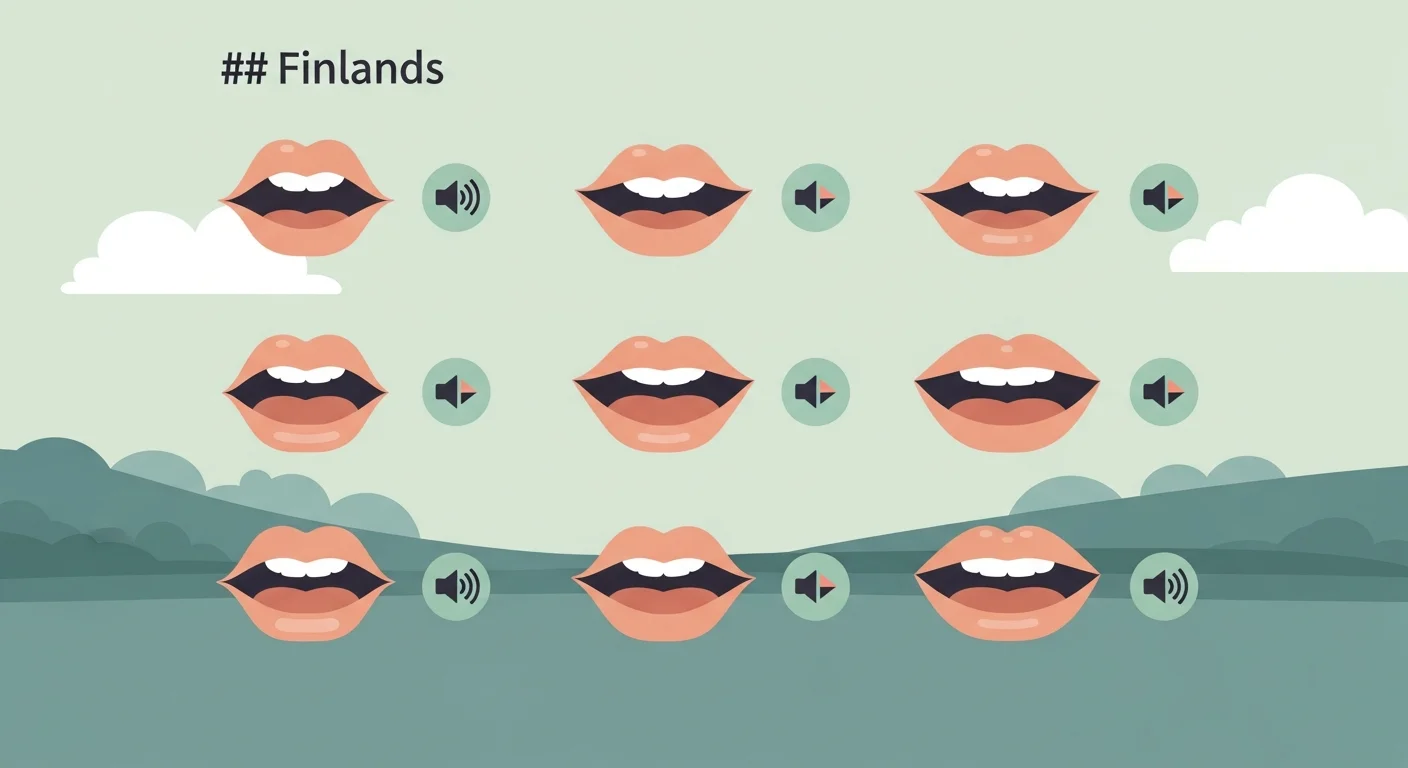
Diphthongs: The Vowel Pairings
Finnish loves diphthongs – combinations of two vowels pronounced in a single syllable. These can feel a bit slippery at first! Here are a few important things to remember.
- The first vowel in a diphthong is usually stressed slightly more than the second.
- Common diphthongs include: ie, uo, yö, ei, äi, öi, au, eu, ou.
- Practice by slowing down the pronunciation at first, then gradually increasing speed.
- tie (road)
- kuolla (to die)
- yö (night)
- Heittää (throw)
Consonants: The Silent "D" and Other Challenges
While Finnish consonants are generally pronounced as they are written, there are a couple of notable exceptions.
- The Silent D: The letter "d" doesn't exist as a standalone consonant. Instead, it appears as a "weak grade" consonant corresponding to "t" in consonant gradation (more on that later!). You will rarely hear it pronounced in speech, and it's not something A1-A2 learners need to focus on.
- Double Consonants: Double consonants like kk, pp, tt, ll, mm, nn, rr, ss are pronounced longer than single consonants. This difference is important, as it can change the meaning of a word! For example: tuli (fire) vs. tulli (customs). Listen carefully to the length!
Key Phrases / Hyödyllisiä ilmauksia
- Anteeksi, en ymmärrä. — Sorry, I don't understand.
- Voisitko toistaa? — Could you repeat that?
- Miten tämä sana lausutaan? — How is this word pronounced?
- Olen vasta aloittelija. — I'm just a beginner.
- Puhutko englantia? — Do you speak English?
- Yritän oppia suomea. - I'm trying to learn Finnish.
Vocabulary / Sanasto
| Finnish | English | Example |
|---|---|---|
| Ääni | Sound | Mikä ääni se on? |
| Vokaali | Vowel | A on vokaali. |
| Konsonantti | Consonant | K on konsonantti. |
| Lausua | To pronounce | Miten tämä lausutaan? |
| Kieli | Language | Suomi on kaunis kieli. |
| Harjoitella | To practice | Minun täytyy harjoitella. |
| Kuunnella | To listen | Kuuntele tarkasti! |
| Toistaa | To repeat | Toista perässäni. |
🇫🇮 Cultural Context / Kulttuuritausta
Finns are generally very direct and appreciate clear communication. Don't be afraid to ask for clarification if you don't understand something! Many Finns are also quite modest about their English skills, even if they are fluent. Showing that you're making an effort to learn Finnish, even if you make mistakes, will be appreciated. And remember, Finns often have a good ear for languages, so they might even be able to help you with your pronunciation! You can find some tips to improve your pronunciation on YLE.
Quick Practice / Harjoitus
- Listen to the following words: kuu, kyy, koira, kerra. Which words have rounded front vowels?
- How would you ask someone to repeat a word in Finnish?
- Try to pronounce the following diphthongs: ie, yö, au. Record yourself and compare it to native speakers online using Forvo.
Conclusion
Mastering Finnish Pronunciation: Taming the Toughest Sounds takes time and practice, but with dedication, you can achieve fluency. Don't be afraid to make mistakes – they are a natural part of the learning process. Keep listening, practicing, and immersing yourself in the Finnish language. Onnea matkaan! (Good luck on your journey!) To continue learning, check out some Finnish language resources.
References
Related Topics
- Finnish Grammar for Beginners
- Essential Finnish Phrases
- Finnish Culture and Customs
Ready to start learning?